
If you use any kind of SEO plugin to monitor your website’s performance, it’s natural to be concerned about the ‘score’. After all, it’s these scores that tell you if you’re on the same page (so to speak) as Google’s best practices. The ones that make you rank higher and get people clicking on your website.
Should I be worried about my SEO plugin score?
Your chosen SEO plugin is just a tool, an indicator that you’re on the right track. It’s not a direct search engine ranking factor. Yes, it can help create meta tags and find spots for internal linking, but it doesn’t understand your goals and audience. Plugins work best as part of an SEO strategy.
So, while you should be aware of your SEO plugin score and take steps to improve it, you shouldn’t obsess over it. Instead, focus on your content, using relevant and well-positioned keywords, website speed and usability, and getting high-quality links that point to your site. Then, use your SEO plugin as a tool to help you optimise your website for search.
Keep reading as we explore these points in more detail and help you uncover the best way to use an SEO plugin to improve your website.
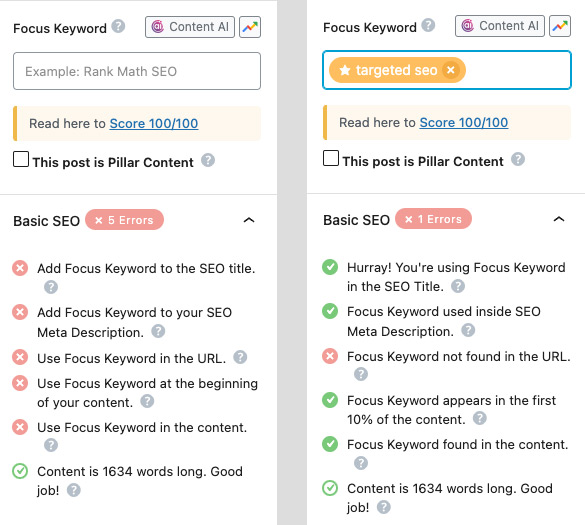
What is an SEO plugin score?
SEO plugins assign a score (usually out of 100) based on your website’s optimisation. Some of the popular WordPress SEO plugins include Yoast SEO, RankMath (our preference at Targeted SEO), and AIOSEO.
The scores are based on various factors, including the quality of your website’s content, the relevance of keywords, the structure of pages, and links within the content. Technical elements, such as meta description and alt text, can also define your site’s SEO score.
Do SEO plugins actually work?
If you’re wondering whether installing an SEO plugin is a sure-fire way to get your website to the top of Google search results, the answer, unfortunately, is no. Plugin scores can be easily manipulated to get that high score you’re looking for without actually affecting your organic goals.
There’s a lot more to SEO than simply running a background tool and hoping for the best.
That said, SEO plugins do make optimising your website easier. They can be used as a checklist for optimisation opportunities like missing meta descriptions, slow site speed and unlinked keywords. They also make common SEO tasks much simpler than they used to be, such as making small changes on a larger scale.
What are the limitations of SEO plugins?
Here’s where website owners get stuck – SEO plugins are by no means perfect, and they certainly don’t cover every angle of search engine optimisation.
What to look out for when using a WordPress SEO plugin:
- Just because you have a high score doesn’t mean you’ll bag a number 1 spot on Google. SEO is influenced by many factors, and while plugins can help you spot potential risks and opportunities, they are just one aspect of a successful SEO strategy.
- SEO plugins can’t optimise your website for every search engine. Most plugins are generally designed with Google in mind, but other search engines (like Bing or Yahoo) have different algorithms and ranking factors.
- SEO plugins won’t fix bad content. No amount of optimisation can make up for poor-quality content. So, if you want to climb the search ladder, you need to make your content readable, relevant, and engaging. Follow Google’s E-E-A-T guidelines to learn more about writing content for humans, not bots.
- No SEO plugin is 100% accurate! Technology is often unpredictable, and most WordPress plugins can be manipulated to show a good score. But this is not a true indicator of your website’s performance.
- SEO plugin tools shouldn’t replace your SEO strategy. We have enough experience in organic SEO to tell you that. Plugins are best used alongside an existing SEO strategy to flag issues and identify optimisation opportunities.
Do I need an SEO plugin for my WordPress site?
If you use WordPress, SEO plugins can be helpful as part of a wider SEO strategy. They help identify areas of your website or WordPress blog that need optimising and provide useful on-page SEO suggestions.
But to really get the most out of an SEO plugin, you must be willing to put in the time and effort to optimise your web pages. This means looking beyond the scores and actually understanding what they mean. Are they a priority to your site? Do they align with your current goals?
Plugins help, but they are by no means magic. Plus, search engine algorithms are constantly changing (something we often discuss on LinkedIn). Stay up to date with the latest SEO best practices, and remember to update your SEO tools regularly!
Will an SEO plugin get me to position 1?
We’ve said it before, and we’ll say it again: no SEO plugin can guarantee a #1 ranking on Google. It all depends on a mix of factors, such as the relevance of your content and keywords, user experience, site speed, mobile friendliness, and high-quality backlinks.
How to make the most of your SEO plugin
Let’s take a look at the bigger picture. While SEO plugins are useful for flagging improvements, they are not the be-all and end-all of SEO.
So, how do you use an SEO plugin to your advantage?
You need to make it part of a broader SEO strategy that includes an SEO content plan, regular site audits, and link-building.
Target relevant keywords that your audience is likely to search for. This means getting into the mind of your audience – they might not be ready to buy your product or service just yet, but that doesn’t mean they aren’t researching it. Keyword research tools can help you do this, and SEO plugins can help you put those keywords in the right places (headings, meta tags, and alt text).
Plugins make it really easy to focus on the score going up, but you shouldn’t just put keywords anywhere for the sake of it. Instead, focus on creating relevant content that connects with your target audience. Google much prefers websites that create people-first content, and your audience will too.
So, should I be worried about my SEO plugin score?
Ah. The answer you’ve been waiting for.
There are many SEO tools out there, and since SEO is largely based on stats and figures, it’s only natural to worry. But you shouldn’t lose sleep over a plugin score that isn’t showing green.
An SEO plugin can be a helpful tool when used as part of a larger SEO strategy. You need to hit the sweet spot between pleasing the search engines and your audience. Instead of worrying about the score, focus on creating a well-structured site with the right keywords and content that speaks to your audience.
And, if you’re really struggling, reach out to an SEO specialist. We are the experts, after all.
Talk to the team at Targeted SEO…
Targeted SEO is a small agency making a big impact when it comes to climbing Google rankings. We have even just been shortlisted for Best Small SEO Agency by the UK Search Awards 2024!
If you’re new to search engine optimisation and want to find out more about how it can help your business, then don’t hesitate to get in touch. Just give us a call on 0800 2062673 or fill out our contact form.
We love what we do here and are more than happy to answer any questions you might have and always welcome a friendly chat about your business.