
How SEO for financial services is evolving as clicks decline
For many companies in the financial services sector, 2025 felt uncomfortable from a search perspective. Many of the ways finance companies rely on search to attract new customers, such as clicks from organic website traffic and referrals from comparison sites, no longer feel as dependable as they once did.
At the same time, one fundamental thing hasn’t changed: people are still actively searching online for financial products and services. What has changed is how people discover financial information, how it is presented to them, and how that early understanding shapes their decisions.
As search becomes more conversational and AI summaries become more comprehensive and reliable, users are less likely to visit multiple websites to help them make a decision.
So the question financial services companies must consider is:
How do we maintain visibility among our target audience and drive enquiries when fewer searches result in a click?”
This article discusses what the shift in search means for the financial services industry and how SEO’s role is evolving to include both traffic generation and AI visibility.
What FinServ search looks like in 2026
Finance-related questions are increasingly being conducted using AI search tools, rather than through the familiar pattern of search engine → click → browse.
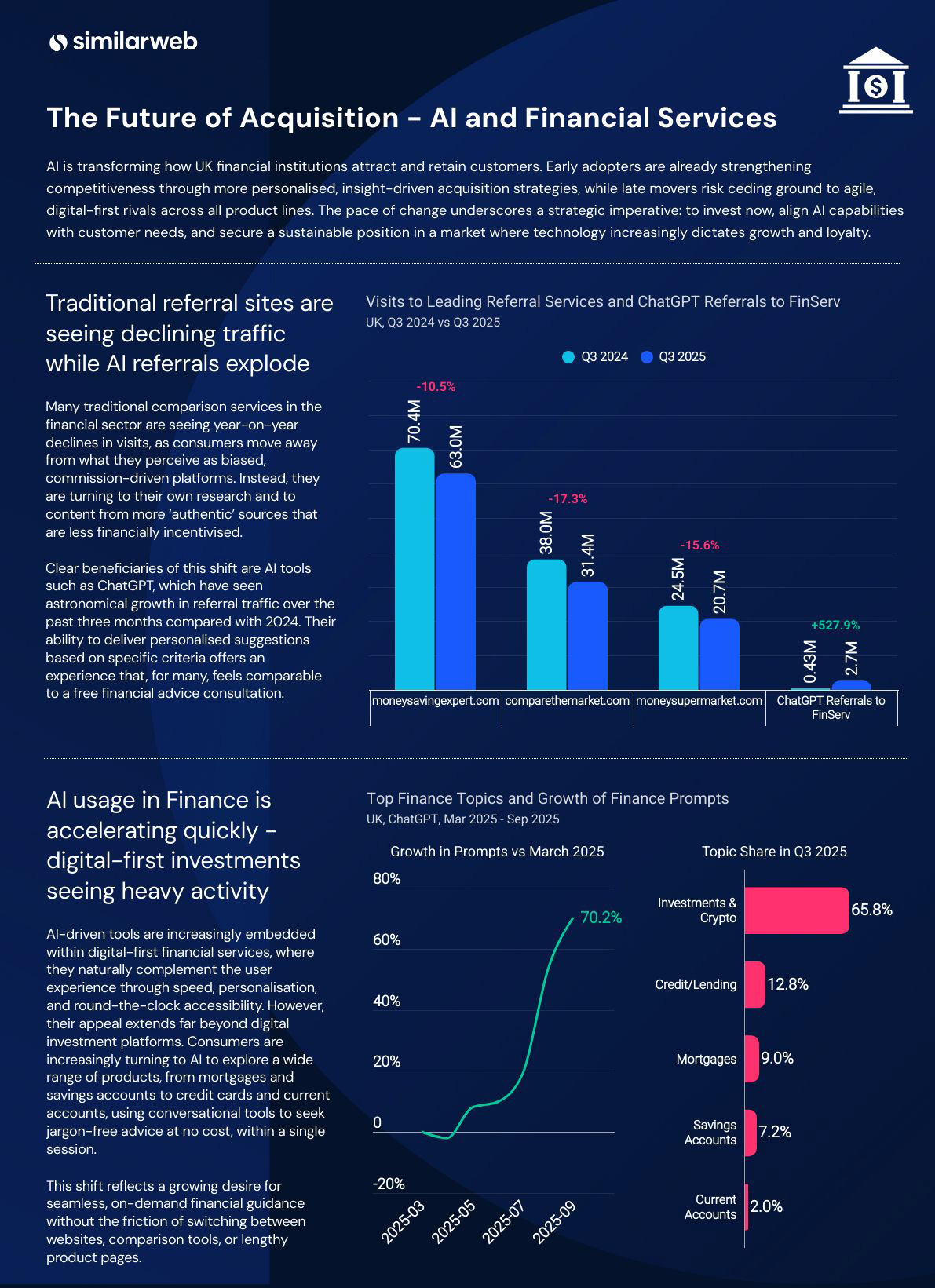
Recent data from Similarweb indicates that the impact is significant. According to their data, ChatGPT referrals to UK FinServ increased by 527.9% year on year to 2.7 m (from Q3 2024 to Q3 2025).
Comparison sites are not immune to this shift. Historically, they have tended to benefit when other parts of the search ecosystem declined, due to their speed and convenience. However, Similarweb data shows that this pattern is no longer holding.
This doesn’t mean comparison sites will disappear overnight, of course. But it does suggest they are no longer the default starting point for many customers, as AI systems increasingly offer the same speed with added context and nuance.
So, as a B2B financial brand, what does this mean for your SEO efforts?
Historically, many SEO strategies in financial services, both B2C and B2B, were built to capture people at the point of comparison. This usually meant ranking for rate, product, or service-led searches, then relying on users to click through comparison tables, reviews and multiple websites to continue their research.
That model assumed discovery and decision-making happened after the click. Increasingly, that is changing.
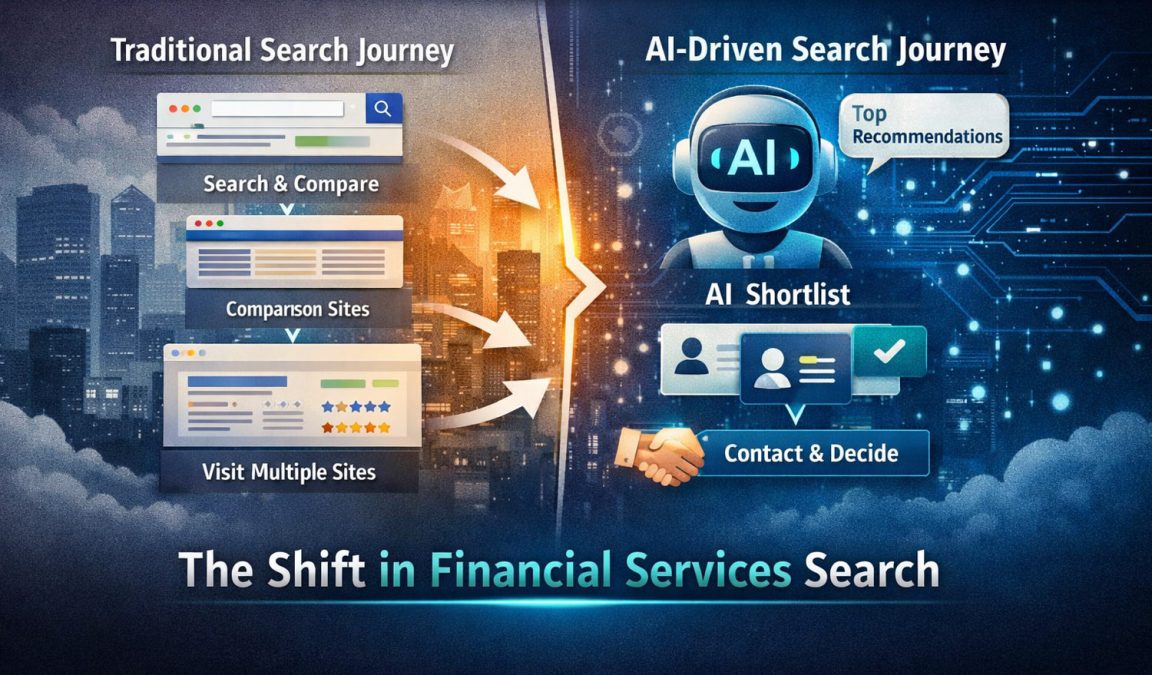
What the financial services search journey looks like before and after AI
A traditional, search engine-based query might have started:
“How to find a good mortgage broker”, followed by“Mortgage brokers near me”.
Many people may have skipped straight to question two depending on how committed they were. From there, they may have scanned page 1 of the search results, checked Google Business Profiles, looked at star ratings, visited several firms’ websites, and compared services and costs.
B2C customers may also have used comparison sites. It’s likely they visited multiple providers’ websites a few times before contacting them.
Fast forward to 2026. Someone using ChatGPT may ask:
- What are the top 5 things to look for in a mortgage broker?
- Which ones near me fulfil that criteria?
- Shortlist 2 for me to contact
Essentially, they have outsourced the early search stages, comparison, filtering and shortlisting to AI. They may click on one or two sites, but at that stage, it’s more about validation and reassurance than discovery. They are close to making a decision.

The takeaway is simple:
Visibility without the click still shapes decisions. But it does mean less visibility for many sites.
There’s no easy way to sugarcoat it: if these trends continue, strong search rankings and even top of page-one positions will no longer guarantee clicks.
To appear in AI-driven search results and win the smaller number of high-intent visits that remain, it’s time to invest in or increase your SEO efforts.
Why AI search is an opportunity for financial services companies
Financial regulators demand transparency and accountability in how financial information is presented. This is an advantage: AI requires the same transparency and accountability to recognise, interpret, and cite information in response to queries.
AI models consistently favour:
- Strong technical foundations: Clean site architecture, consistent internal linking and accessible page structure help AI systems reliably process and reference content at scale.
- Clear, authoritative primary sources: Websites that explain their own products or services plainly and take responsibility for the information they publish.
- Well-structured explanatory content: Pages that answer questions directly (what it is, who it’s for, risks, costs, pros and cons) in clear language, and not content written purely to rank.
- Consistent trust signals: FCA registration details, professional qualifications, transparent pricing explanations, up-to-date policies, and real-world evidence (case studies, examples, FAQs).
- Specialist, niche-led positioning: Firms that clearly state who they help and why (e.g. specific client types, industries, or financial situations) are easier for AI to summarise and recommend than generalists.
- Widely corroborated sources: Information that aligns with trusted third-party references (regulators, established publications, professional bodies) and doesn’t contradict widely accepted guidance.
So, if your financial services website:
- is well structured with strong UX and technical SEO
- adheres to industry regulations and guidelines
- explains simply what you do and who you do it for
- is a source of verified and helpful information
- contains social proof (case studies, reviews), and
- proves your credentials,
then it is more likely to show up in AI search results.
To achieve this, your website content SEO content marketing strategy needs to be watertight. It must be well researched, planned, governed, written and implemented.
SEO’s evolving role in financial services
SEO isn’t disappearing from finance. Its role is evolving.
SEO-led websites and professionally produced content can significantly increase your chances of showing up in AI searches and gaining long-term authority.
Here’s how.
1. From demand capture to trust formation
In the past, SEO has focused heavily on capturing demand at the point of comparison, by ranking for high-intent keywords and driving organic traffic.
Now, SEO is playing a larger role earlier in the journey. Our job is to help users, AI tools and search engines understand and trust information.
How: SEO content strategy needs to focus on creating plain-English content that answers real questions, adds context and demonstrates expertise and credibility.
2. From ranking pages to being referenced
SEO is no longer all about ranking; it’s also about being referenced in AI search. This is great news for FinServ businesses that are willing to invest in a strong website and content strategy.
Not only will that investment help them generate high-intent clicks and enquiries, but it will also help build customer loyalty and long-term authority. Over time, with continued effort, they can become a brand to be reckoned with.
How: By producing expert-led, well-structured content with named authors, consistent terminology, clear explanations of risks and limitations – not surface-level summaries crammed with keywords.
3. From single metrics to blended signals
Clicks still matter, of course. But on their own, they no longer tell the full story.
In 2026, effective SEO measurement is less about ranking and counting clicks and more about understanding influence. We use blended analytics, attribution modelling, and engagement signals to reflect how decisions are actually made.
Finance companies should consider a broader range of metrics, such as:
- Growth in branded search and direct traffic trends: This signals increasing awareness and trust, as more people actively search for your brand by name. Direct traffic reflects familiarity and confidence, with users choosing to visit your site directly rather than via comparison or search results.
- Assisted and multi-touch conversion paths: Evidence that search content influences decisions earlier in the journey, even if it isn’t the final click before conversion.
- Engagement quality when users do arrive: Increasing engagement signals such as time on page, scroll depth, navigation behaviour and taking next steps (e.g., booking a callback).
- Ongoing visibility in response to high-value search queries: Mapping core subjects to measure topical authority, and monitor how reliably your content appears across traditional and AI search.
By shifting performance metrics away from rankings and number of sessions, and towards how SEO contributes to awareness, trust and downstream decision-making, finance companies can gain a far more accurate view of their website’s value.
Important considerations
As search evolves and organisations respond to this shift, there are a few pitfalls to avoid.
Chasing AI-specific tactics won’t cut it
There’s no shortcut to being trusted. Superficial attempts to “optimise for AI” risk producing content that is neither credible nor compliant, and may be weaker than what came before.
Generic content is not enough
Basic, surface-level content is easy for AI to summarise, but just as easy to ignore. The value now lies in nuance, context and authoritative advice.
Cutting back on SEO
Reducing investment purely because clicks are down is to misunderstand SEO’s evolving role. SEO is no longer measured mainly by how many clicks it delivers, but by how effectively it shapes understanding, trust and preference before a customer ever takes action.
AI-led search still depends on strong SEO fundamentals: clear, well-structured content, accessible websites and information that can be trusted and referenced.
At Targeted SEO, our focus has long been on reader-first content that explains complex topics clearly and responsibly, making us the ideal SEO partner for finance companies looking to grow online visibility and enquiries in 2026.
Talk to us about finance SEO strategy
Finance companies that recognise rankings are no longer a guaranteed route to clicks, and are willing to adapt their SEO strategy, are on the right track in this new age of search.
Targeted SEO works with regulated financial services brands to build visibility based on trust, clarity and accountability, not shortcuts. Our experience helping finance companies navigate changing search behaviour speaks for itself.
Read our SEO case studies to find out how we’ve helped mortgage brokers and accountants grow their businesses.
If you want to understand how AI-led search is affecting your visibility and where SEO can still make a measurable difference, get in touch to arrange a free consultation.