
Why do businesses want a one-off SEO project instead of ongoing SEO?
Some businesses we speak to don’t come to us asking for ongoing SEO.
It’s usually something more like…
“Can we just do a one-off project to fix everything first?”
That’s a reasonable way to look at it. If your website isn’t performing well, it’s easy to assume something’s broken. The instinct is to fix it, tidy things up, and move on.
There’s often more behind that. Sometimes it’s caution, especially if they’ve worked with an agency or SEO provider before and didn’t see value month to month. Other times, it’s wanting something more defined with a clear start and end.
The problem is, SEO doesn’t really work like that.
What a one-off SEO project actually does
A one-off SEO project can be really valuable, especially if a website hasn’t had much attention from an SEO perspective before.
In most cases, it focuses on getting the fundamentals in place.
That usually starts with a series of audits. These examine how the site is built, how pages are structured, how content is used, and where gaps exist compared to competitors. This gives a clear picture of what’s holding the site back and where the quickest opportunities lie.
From there, the focus shifts to fixing those issues.
That might include resolving crawl or indexing issues, improving page titles and descriptions, refining how key pages are structured, and ensuring content better matches what people are actually searching for.
There are often some quick wins as well. Pages that are already ranking but could perform better with a bit more optimisation. Small changes that can lead to noticeable improvements in visibility or click-through rate.
By the end of a project, the website is usually in a much stronger position. It’s cleaner, more aligned with search intent, and easier for search engines to understand.
And that’s exactly what a one-off SEO project is designed to do.
What most businesses expect to happen next
Most clients don’t expect miracles… but they do expect momentum.
There’s usually an assumption that once the main issues are fixed, the website will naturally start to perform better. Visibility improves, traffic increases, enquiries and sales follow. Maybe not overnight, but steadily, with minimal additional input.
It’s also quite common to think of it as a reset. As if the site was underperforming because something wasn’t quite right, and now that’s been addressed, it can finally reach its potential.
And in some cases, that does happen to a degree.
You might see some early movement, especially if there were clear technical issues or missed opportunities.
But that’s usually where things start to level off.
Where one-off SEO starts to fall short
In the first few weeks after, it is possible to often see some positive signs.
Search engines can start to recrawl the website, so indexation improves. Pages are clearer, better structured, and easier to understand. In some cases, you might even see a few ranking improvements, especially for pages that were already close to performing well.
But beyond that, things tend to stabilise.
Traffic might tick up slightly, rankings might move a little, but it rarely continues in a meaningful way. And that’s usually where expectations and reality start to diverge.
The reason is fairly simple. One-off SEO fixes what’s already there, but it doesn’t create anything new. One-off projects are limited in scope and do not provide the sustained effort needed for ongoing growth.
It doesn’t expand your reach into new searches or build authority over time. It also can’t keep pace with competitors who keep investing in content, links, and their organic presence. Ongoing SEO lets you act on these insights to stay competitive and improve visibility over time.
So while the website is in a much better position, it’s not really progressing. It’s just sitting there, waiting for something else to happen. Occasional updates may suffice for low-competition niches, but most sites need more to maintain and improve organic visibility.
Why SEO is an ongoing process
The simplest way to think about SEO is that you’re building something over time.
It’s not just about fixing a website; it’s about turning it into an asset that consistently brings traffic, enquiries, and revenue. Ongoing SEO requires continuous strategy, content creation, on-page, and performance monitoring to drive organic growth.
And that doesn’t really happen from a one-off piece of work.
Once the foundations are in place, there are still several moving parts that determine whether a site actually grows.
There’s the content side. Expanding into new searches, answering more specific questions, and covering topics in more depth than competitors. A robust SEO content strategy and high-quality content are essential for long-term growth, helping to build trust, authority, and ongoing relevance.
There’s authority. Earning trust signals over time, whether that’s through backlinks, brand mentions, or simply demonstrating expertise and experience in your space.
There’s also the website itself. Improving how pages perform, refining messaging, and making it easier for users to take action and convert once they land on the site.
All of that happens within a competitive environment. Other businesses publish content, improve their websites, and invest in SEO simultaneously.
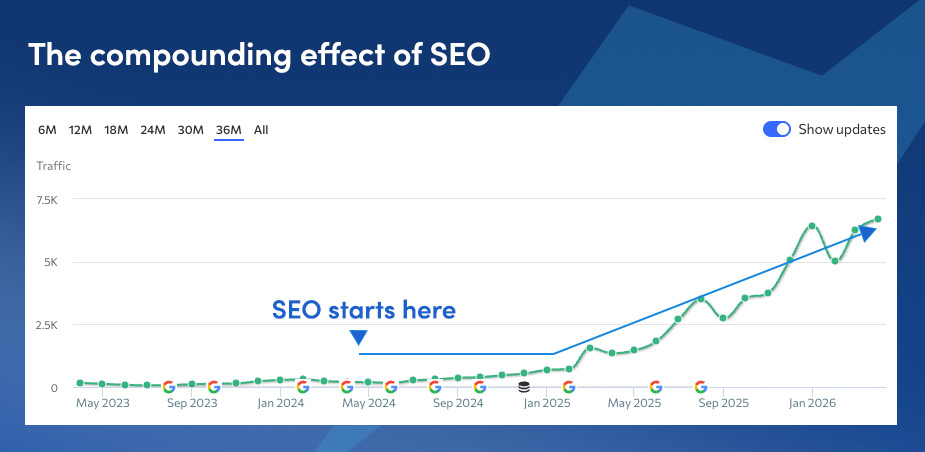
So while a one-off project gets everything in place, it’s the ongoing work that actually builds momentum. Ongoing SEO results compound over time, strengthening domain authority and producing a better ROI as visibility grows.
That’s what turns a website from something that exists into something that consistently performs.
One-off SEO vs ongoing SEO: what’s the difference?
Here’s a simple way to compare the two:
| Aspect | One-Off SEO | Retained SEO |
|---|---|---|
| Primary goal | Fix issues and improve existing setup | Grow traffic, leads, and revenue over time |
| Timeframe | Short-term (4–8 weeks typically) | Long-term, ongoing |
| Focus | Audits, fixes, quick wins | Content, authority, CRO, continuous improvement |
| Results | Initial improvements, stabilisation | Compounding growth over time; monthly SEO is designed to improve and maintain search visibility through continuous optimisation |
| Content | Limited optimisation of existing pages | Ongoing content creation and expansion |
| Authority building | Minimal | Continuous (earning links, brand signals, E-E-A-T) |
| Adaptability | Static (once complete) | Ongoing refinement based on performance, regular technical audits and fixes, content strategies, continuous keyword tracking, and adapting to changes in search engine algorithms and user behaviour |
| Competitiveness | Helps you catch up | Helps you compete and win; monthly SEO packages typically include ongoing optimisation services such as technical audits, content strategies, and competitor tracking |
| Long-term impact | Plateaus | Builds a sustainable growth channel; monthly SEO adapts to continuous algorithm changes, ensuring your business remains visible and competitive |
A more practical approach – combining both
In reality, it doesn’t have to be one or the other.
A lot of businesses start with an SEO audit and actions, and that’s often the right place to begin. It gives you a clear understanding of where the website currently stands, fixes the obvious issues, and gets everything into a much stronger position.
From there, the question becomes what you actually want the website to do.
If the goal is simply to tidy things up and leave it there, a one-off SEO project might be enough.
If the goal is to generate more traffic, enquiries, and revenue, an SEO audit is just the starting point. Ongoing SEO requires continuous attention to maintain and improve search visibility as algorithms, competitors and AI tools evolve.
What tends to work best is treating it as a phased approach.
To help visualise how this can be implemented, here’s a simple two-phase plan that many businesses follow:
Phase One: SEO Audit and Fixes
A thorough paid SEO audit identifies technical issues, content gaps, and structural problems. The focus is on resolving anything holding the site back and improving key pages so they are aligned with search intent.
Phase Two: Ongoing Content and Monitoring
Once the foundation is in place, the focus shifts to growth. This includes creating new content, improving internal linking, building authority, and refining the site based on real performance data.
The first phase focuses on laying the foundations. The second phase focuses on growth.
That might include:
- creating new content targeting high-intent searches
- improving internal linking and site structure
- building authority through external signals
- refining pages based on user behaviour and performance data
Over time, these small improvements compound, and that’s usually when SEO becomes commercially valuable.
Conclusion
If you’re weighing up one-off SEO vs ongoing SEO, it usually comes down to what you want from your website.
If you’re looking to fix issues and improve what’s already there, a fixed price SEO project can absolutely help.
But if you want your website to become a consistent source of traffic, enquiries and sales, it’s rarely a one-off job.
In most cases, it’s something that builds over time. The businesses that treat it that way are usually the ones that see the biggest return from it.
Can SEO be worked on as a one-off project?
SEO can absolutely be worked on as a one-off project, and in some cases it’s a sensible place to start. An SEO audit is useful for identifying and fixing issues that might be holding your website back, whether that’s technical problems, poor page structure, or content that isn’t aligned with what people are searching for. The limitation is what happens after that. A one-off project improves what’s already there, but it doesn’t create ongoing growth. It doesn’t help you target new searches, build authority over time, or adapt to changes in search behaviour and competition. So while one-off SEO can be valuable, it’s usually just the first step rather than the full solution.
How long does SEO take to see results?
This is one of the most common questions, and the honest answer is… it depends. In the short term, you might see early signs of improvement, especially if there were clear issues to fix. But meaningful results take longer. For most websites, you’re looking at around 3 to 6 months before you start to see consistent improvements in visibility and traffic. In more competitive industries, it can take longer. SEO builds over time. The work you do early on supports everything that comes after, which is why results tend to compound rather than appear all at once.
Is ongoing SEO worth it?
Ongoing SEO is what turns a website into a reliable lead and sales generation channel. A one-off project might improve your current position, but continued work is what actually drives growth. It allows you to expand into new areas, target more specific searches, and continually improve how your website performs. It also gives you the ability to adapt. Search behaviour changes, competitors evolve, and Google updates how it ranks websites. Without continued work, it’s difficult to respond to those changes, which is often why websites plateau after an initial improvement.
What happens if I stop investing in SEO?
If you stop SEO after the initial work, the improvements you’ve made don’t disappear overnight. Your website will likely remain in a better position than it was before. But over time, things begin to slow down. Competitors continue to invest, search trends shift, and new opportunities emerge that your site isn’t targeting. Without ongoing work, your site gradually becomes less competitive. Visibility can slip, traffic can stagnate, and growth can slow or stop altogether. It’s less about losing everything, and more about being overtaken.