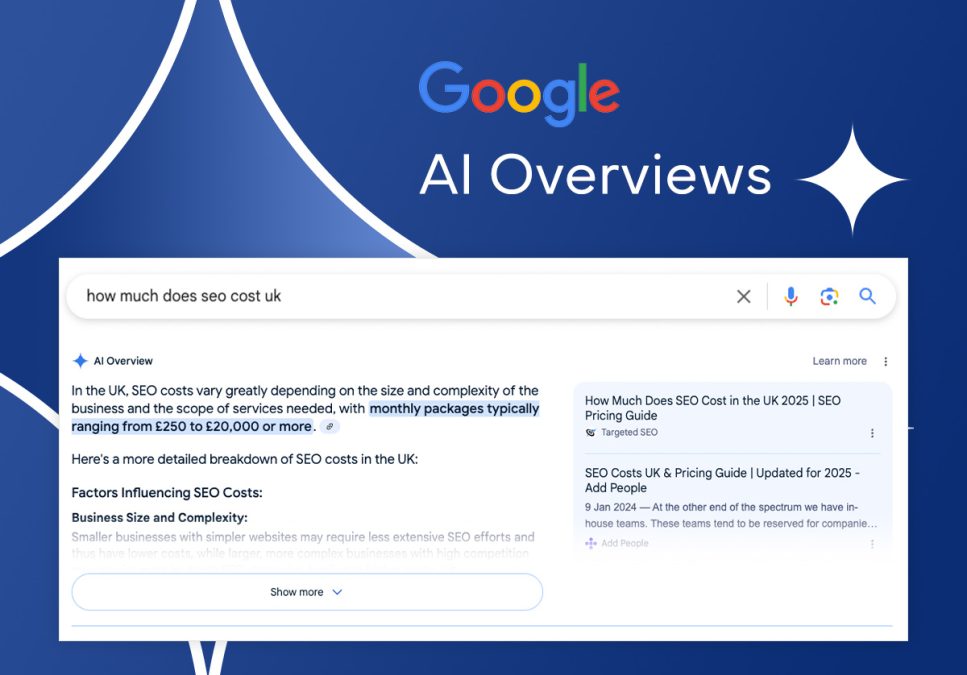
Why Google’s AI Overviews Matter for Your SEO
Google has changed how people interact with search. The introduction of AI Overviews means answers are now being generated directly by Google’s own AI – and they often appear right at the top of the results page.
If your business relies on organic search to bring in new leads, this shift matters. These AI snapshots can push traditional results further down, which means it’s more important than ever to understand how they work and how your content can be featured.
At Targeted SEO, we’ve seen first-hand how AI Overviews can help small and medium-sized businesses appear at the top of search – even above traditional organic listings.
This guide explains what Google’s AI Overviews are, why they matter, and how to optimise your content to be included.
What is a Google AI Overview?
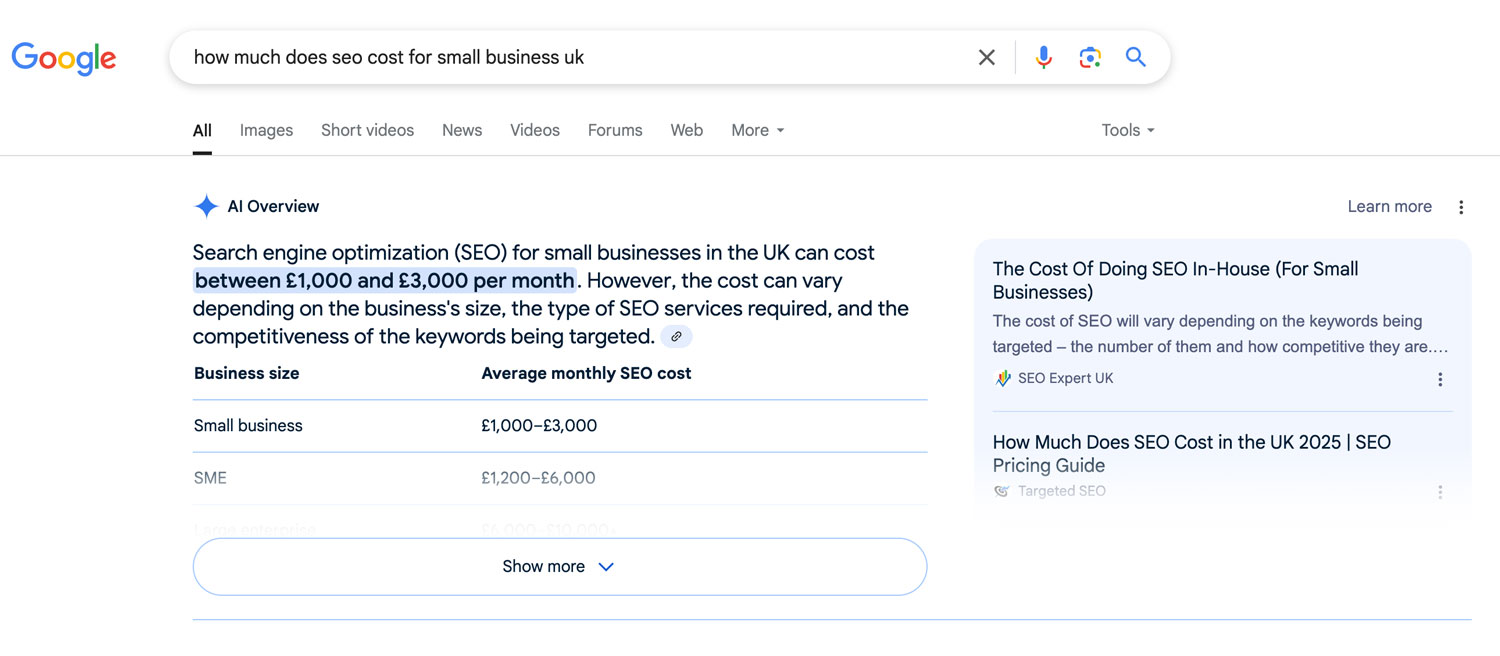
AI Overviews are summaries that Google’s AI creates to answer a user’s search query quickly. They appear above the usual search results and pull information from websites Google trusts, often linking back to those sources.
For your website, this opens up a powerful new way to be seen. You don’t need to be a big brand. If your content is clear, useful, and accurate, it can be featured. AI Overviews are based on relevance, not just keyword placement. That means small businesses with helpful, well-written content can still compete.
If you’re not in the top spot organically, an AI Overview citation can still put you in front of your audience, sometimes even ahead of larger competitors.
When did AI Overviews Start Appearing?
Google launched AI Overviews on 14 May 2024. Since then, they’ve become a regular part of many search results, especially in industries like health, finance, and local services. These AI snapshots now appear across a growing number of queries, often showing up before any traditional organic listings.
If you run a business and want more people to find your site, this is something to pay attention to.
Many of our long-standing SEO clients are already being cited in AI Overviews for important search terms.
That visibility isn’t a coincidence, it’s the result of steady SEO work, clear content, and a strategy built around search intent.
What Kind of Searches Trigger AI Overviews?
AI Overviews mostly appear when people ask questions, especially detailed ones. Searches like “how much does SEO cost for small business” or “what’s the best CRM for small business” are more likely to trigger an AI-generated summary at the top of the page.
These are called informational queries, users want answers, not just links.
But other types of searches can trigger AI Overviews too:
Navigational queries, like “HMRC self-assessment login,” sometimes show summaries that guide users to the right page.
Transactional queries, like “buy business insurance UK,” may pull in product comparisons or service details if the search intent is clear.
If your content answers these types of questions well, you improve your chances of being featured. The format matters too, AI Overviews favour pages that are well-structured, easy to scan, and quick to answer the question upfront.
How Google’s AI Overview Works
Google uses artificial intelligence to summarise answers to search queries. This process happens in three steps:
Understanding the question: Google looks at the query to figure out what the user wants to know.
Finding content: It searches for web pages that are relevant, trustworthy, and easy to understand.
Creating an answer: It pulls useful content from those pages and builds a short summary, often with source links.
The key takeaway? If your page is clear, well-structured, and genuinely helpful, there’s a good chance it can be selected. You don’t need to game the system, just write for your audience, and make it easy for Google to see the value.
Why Ranking in AI Overviews Matter for your SEO and Business
If your content is cited (ranking) in an AI Overview, your business gains instant visibility in a high-trust area of the SERPs (search engine results pages). This can lead to more clicks, more enquiries and sales, and greater authority in your niche.
We’ve seen smaller websites benefit massively from this. Google’s AI isn’t looking for the biggest brand, it’s looking for content that gives users the best answer. That means clear, honest information written with the reader in mind has a real chance of being featured.
8 Steps to Rank in Google AI Overviews:
1. Start With a Clear Answer
AI Overviews are built around helping users find answers fast. So your content should do the same. Get straight to the point, especially in the first few lines. If someone is asking “How to register for VAT in the UK?”, your page should open with a simple, accurate answer.
Skip the long intros and filler. AI is more likely to choose content that gives users what they need quickly. This works especially well for longer, more specific questions, like “how-to” guides or definitions, where the AI can pull clear, structured information.
2. Write Blog Content That Serves a Purpose
Publishing regular blog content helps, but quality matters more than quantity. Focus on writing content that answers the real questions your customers are typing into Google. That starts with keyword research and a clear understanding of your audience.
If you’re a surveyor, that might mean answering searches like “What does a property valuation include?” or “Do I need a structural survey?” The goal is to give helpful, well-structured answers, not just content for content’s sake. The more useful your blog posts are, the more likely they’ll be referenced in AI Overviews.
3. Build Trust With Consistent Content
Google wants to show results it can rely on, and so do your customers. That’s why publishing useful, accurate content consistently is key. This matters even more if you’re in a sector where accuracy is crucial, like legal, healthcare, or financial services.
A website with a full library of relevant articles builds more trust than one with a single blog post. Make sure your content is factually correct, easy to read, and clearly reflects your knowledge. That consistency helps your site get picked up, by both AI Overviews and organic results.
4. Show Experience and Expertise That Google Can Trust (E-E-A-T)
To appear in AI Overviews, your website needs to show it can be trusted. That means more than just publishing content, it’s about demonstrating real-world experience and credibility. Google looks for signals like named authors, original content, and clear business information.
If you’re the expert, say so. Mention how long you’ve worked in your field. Add helpful examples based on your day-to-day knowledge. Content backed by real experience is more likely to be chosen, both by users and AI.
5. Keep Your Content Clear and Easy to Read
If someone lands on your page, they should be able to scan and understand it straight away. Use short paragraphs, clear headings, and simple language. Avoid long blocks of text or technical terms that only experts understand, remember, AI is scanning your page too.
It also helps to use structured data. This is behind-the-scenes code that tells Google what your page is about, making it easier to surface in things like AI Overviews and rich results.
6. Use Technical SEO To Help AI Understand Your Website
Even the best content won’t be seen if your site has technical problems. For AI Overviews to feature your content, your site needs to be fast, secure, and easy for Google to crawl.
That includes things like mobile-friendliness, secure HTTPS, clean code, and strong internal links. At Targeted SEO, every website we build follows these principles from day one, and we see the difference it makes in AI visibility.
7. Plan Your Content Around User Intent
Google’s AI is smart enough to understand what users are really asking. That means your content needs to focus on real answers, not just keywords. Start by thinking about what your audience wants to learn, then build your content around that.
Use schema markup where it makes sense, especially for FAQs or key service information. It gives Google extra context and can improve how your content appears in AI results.
8. Write for People – and AI Will Follow
Your content should help real people, not just tick SEO boxes. That means answering questions clearly, using examples your audience will relate to, and explaining things in plain English. When content is easy to understand, AI is more likely to feature it too.
If you’re writing about mortgage options, don’t stop at listing the types, explain who each one suits, what to consider, and why it matters. Real insight is what sets your content apart.
Frequently Asked Questions About AI Overviews
Does Ranking in AI Overviews Help Your SEO?
Yes, it can make a big difference. Appearing in an AI Overview puts your content at the top of the page, sometimes even above traditional search results.
Even if users don’t click right away, the visibility builds trust. And when they do click, they’re often more engaged. These aren’t casual visitors, they’re people looking for clear answers, and your site just gave them one.
We track these placements for our clients alongside featured snippets and People Also Ask results. They all work together to increase exposure, drive better traffic, and support long-term SEO growth.
Why AI Overviews Matter for Small Businesses
Your website isn’t just a brochure, it should bring in real leads and enquiries. For small businesses, showing up in search results is one of the most effective ways to get found by people who are actively looking for your services.
But now, search isn’t just about classic rankings. Google’s AI Overviews appear above traditional results. If your content provides helpful, accurate answers to common questions, your business could be featured, even if your site isn’t in the top three results.
This gives smaller websites a real chance to stand out against bigger competitors. The key is clarity. If your content clearly answers a relevant question, it has a chance of appearing in an AI Overview, driving more traffic from the right audience and building visibility in the process.
We’ve seen small businesses earn a spot in AI Overviews by doing the basics well: clear content, fast websites, and consistent SEO. If your site is already performing, this is your chance to push even further.
How Accurate Are Google’s AI Overviews?
AI Overviews are improving, but they’re not perfect. Google says they’re as accurate as featured snippets, which means they usually get things right. Still, there are cases where summaries miss the mark.
This usually happens when the original content is unclear or poorly structured. If your answer is buried in long paragraphs, uses vague language, or covers too many topics at once, Google’s AI might pull the wrong point, or skip your site entirely.
To help your content get picked up accurately:
Keep your answers direct and factual.
Use clear headings and short paragraphs.
Put the most important information at the top of the page.
Example: Say you’re a financial advisor writing about ISAs. If you explain what an ISA is in the first two lines, Google is more likely to use your answer. But if your explanation is halfway down the page in a wall of text, it’ll likely be missed.
Being clear isn’t just better for AI, it’s better for your audience too.
Do AI Overviews Replace Featured Snippets?
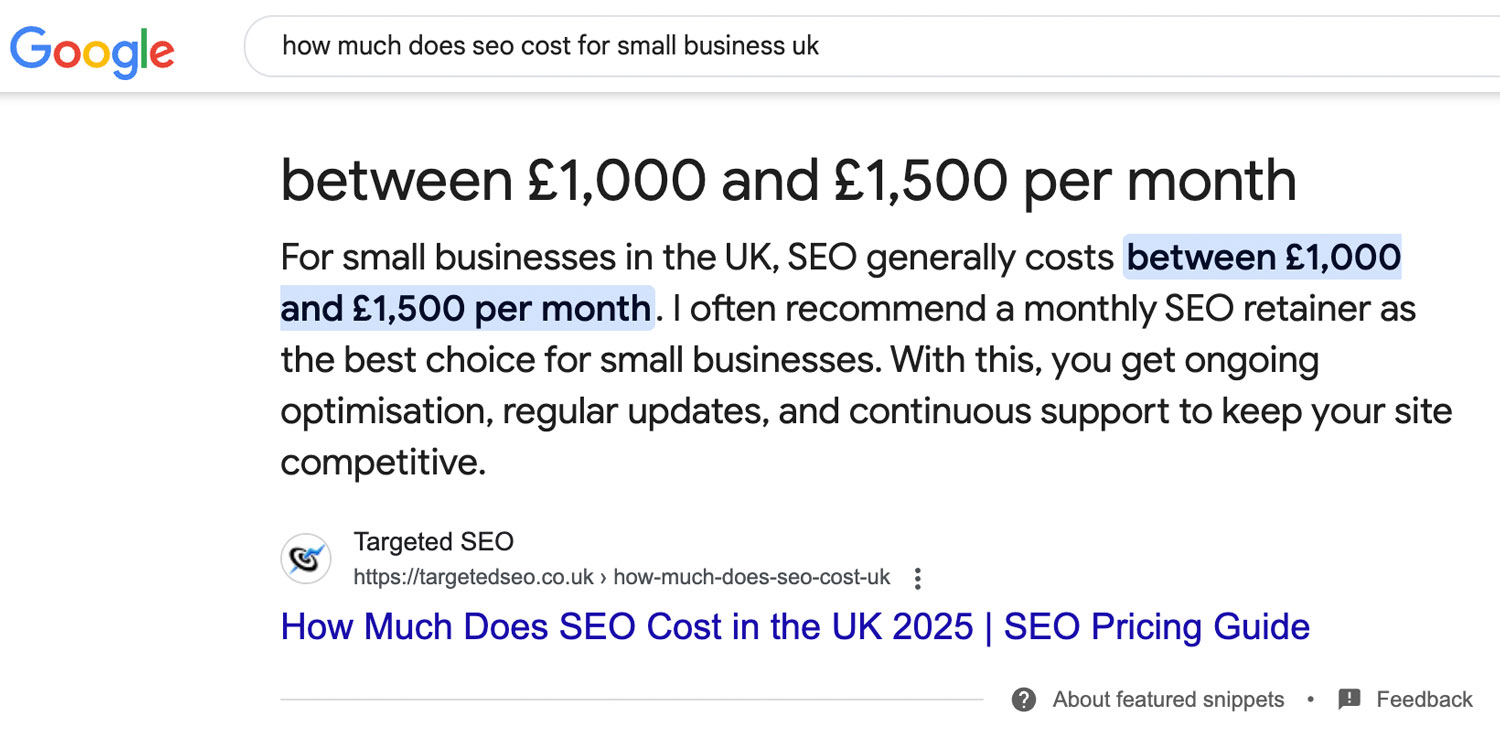
AI Overviews and featured snippets are two separate features, but they can appear in similar positions in search results. In some cases, AI Overviews now occupy the top of the page where featured snippets used to appear, especially for longer, question-based searches. However, featured snippets still show up for many queries, and both features can exist on the same results page.
Think of AI Overviews as Google expanding how it presents information, rather than replacing featured snippets altogether. If your content is clear, structured, and helpful, it still has the potential to be included in either format, or both.
Can You Trust Google AI Overviews?
AI Overviews are mostly reliable, but they’re not always right. They pull information from trusted websites, summarise it, and aim to give users quick answers. But like any automated tool, they can miss detail or oversimplify complex topics.
If you see your business featured in an AI Overview, it’s a good sign. It means Google sees your content as helpful and trustworthy. That said, treat these summaries as a starting point, not the full picture.
The best way to make sure your message is represented properly? Keep your content accurate, easy to follow, and written by people who know what they’re talking about. That’s what Google looks for, and so do your customers.
Will Ranking in AI Overviews Reduce my Website Traffic?
They can, but not always in a bad way.
If users get what they need from the AI summary, they might not click through. That’s the trade-off. But if your website is one of the sources cited in the overview, you gain something else: visibility, trust, and better-quality visits.
We’ve seen this first-hand. Clients featured in AI Overviews often see stronger engagement and more qualified leads. It’s not about chasing every click, it’s about attracting the right ones.
By staying visible in both AI and organic results, you keep your website working hard, even as search behaviour changes.
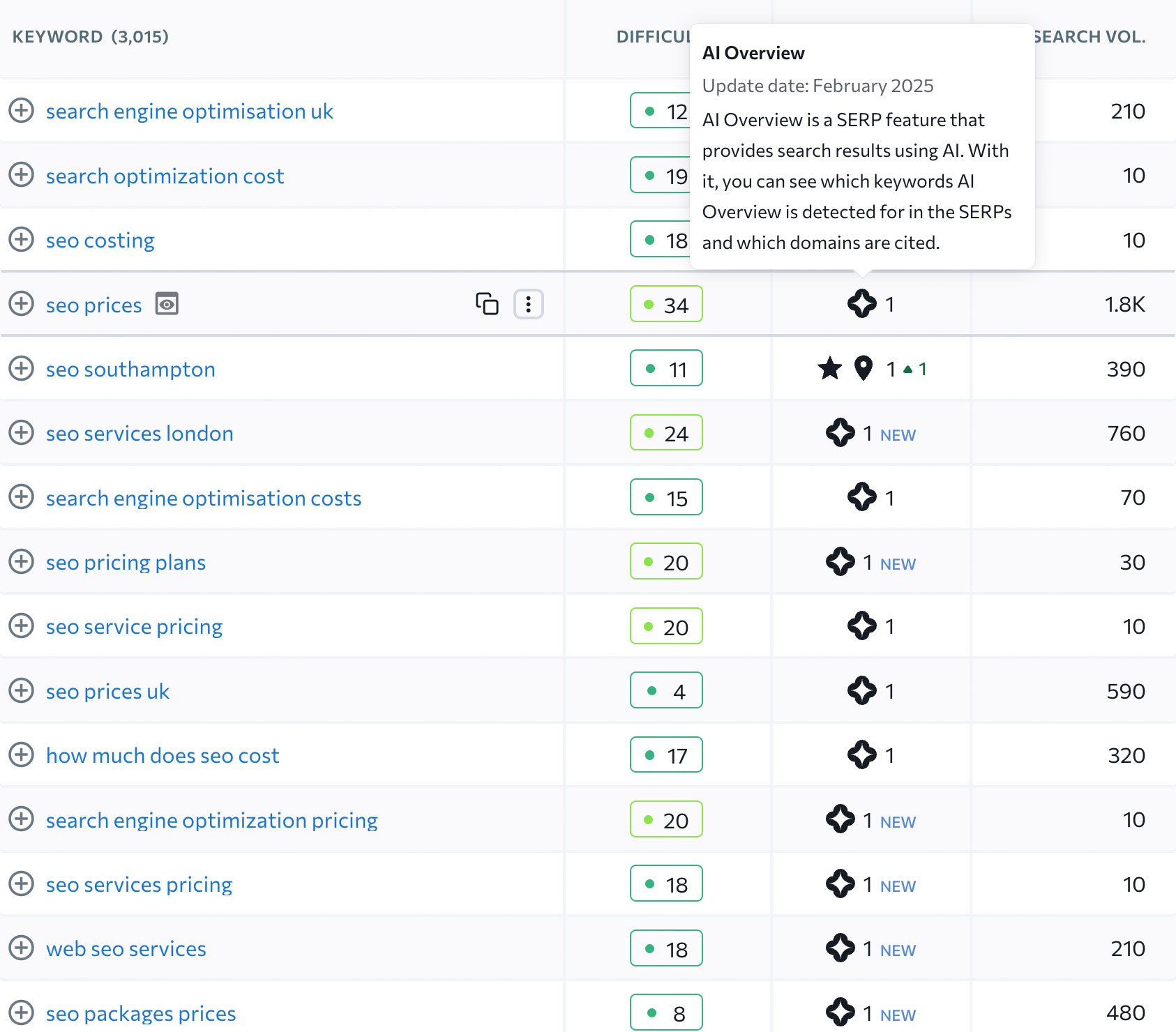
How Can You Track Google AI Overview Visibility?
Tracking performance in AI Overviews isn’t as straightforward as traditional SEO, yet. Right now, Google Analytics and Search Console don’t show AI Overview clicks as a separate metric. But there are ways to spot the signs.
Here’s what you can do:
Watch for increases in long-tail traffic related to questions you’ve answered in your content.
Monitor impressions and clicks for relevant queries in Google Search Console.
Use software like SE Ranking, Semrush and Ahrefs to track visibility for AI Overviews.
The software is improving, and we stay up to date so our clients know what’s working. If you’re starting to see more high-intent queries bringing people to your site, that could be AI at work.
How to Measure SEO Success with AI Powered Search
Getting your content into AI Overviews is one thing. Knowing it’s working is another.
Here’s what to track:
Organic traffic – Are more people visiting your site from question-based searches?
Impressions and clicks – Are your pages being seen in search results, and are users clicking through?
Conversions – Are those visitors filling out forms, calling your business, or taking the next step?
These metrics tell you whether your content is being found, read, and acted on. If you’re seeing growth in traffic from longer search queries or an increase in leads from blog content, it’s a sign your AI-focused SEO is working.
At Targeted SEO, we measure success by results, not just visibility. That means tracking what matters and adjusting strategy based on real data.
How AI Software Can Support Your SEO Strategy
AI software can be a useful part of your SEO workflow, not a replacement for strategy, but a way to save time and spot opportunities. These tools can help you:
Research the questions people are asking online
Spot keyword gaps your site isn’t targeting yet
Analyse top-performing content to see what’s working
Find ways to improve page speed, structure, or mobile usability
Used well, they help you focus on what matters: writing clear, relevant content that matches search intent. Whether you’re writing blog posts, updating service pages, or reviewing site structure, AI-powered tools can give you helpful insights, but they still need your input to be effective.
Our SEO specialists use a combination of human-led strategy and AI-assisted software to make sure content is written for users first and search engines second.
Do You Need To Get Featured in AI Overviews?
Many of our clients now rank in AI Overviews for searches closely linked to their services. That doesn’t happen by accident, it comes from doing the core SEO fundamentals well:
A strong keyword and content strategy
Clear, helpful writing that matches user intent
Fast, well-structured websites with solid internal links
SEO support that keeps improving month after month
If your site has the potential but isn’t being seen, we’ll help fix that. We focus on what works and keep things clear every step of the way.
Ready to Improve Your Visibility with AI-Optimised SEO?
AI Overviews aren’t just a new feature, they’re a sign of where search is headed. If your website isn’t already showing up for AI-generated results, now’s the time to do something about it.
We help small and medium-sized businesses improve visibility through smart, sustainable generative engine optimisation, and that includes preparing your website for AI-powered search. Whether you need help writing better content, improving site structure, or building a clear SEO strategy, we’re here to help.
✅ We’ve already helped many of our retained clients appear in AI Overviews
✅ We build websites with SEO and AI-readiness baked in
✅ We don’t just offer advice – we do the work that gets results
If you want a website that works harder for your business and a strategy built for where search is going, we’d love to talk.
Get in touch today to speak to an SEO consultant. Let’s make your site the one that shows up, and stands out.
From SEO to GEO: How to Optimise for AI-Powered Search Results.