
If your SEO efforts feel harder than they should, it’s time to look at the source of the issue. Many business owners invest in content and optimisation, only to be frustrated by a lack of progress. Often, the problem isn’t the SEO campaign itself, but the website it’s built on.
SEO struggles often stem from weak website foundations. If your site isn’t clear, fast, and well-structured, SEO will be slower and less reliable. SEO web design creates websites that are designed to be found, prioritising structure, performance and content.
This article explains why website design and SEO are intrinsically linked, why separating them limits performance, and how SEO web design is often best for long-term visibility. It also helps you recognise when your website may be holding SEO back, and what to do next.
If you’re unsure whether your website is supporting or holding back your SEO, speak to Targeted SEO. We offer honest advice and objective SEO website audits to help you decide the right next step.
Why SEO results rely on solid website foundations
Most SMEs don’t struggle with SEO because they chose the wrong keywords or didn’t publish enough content.
They struggle because their website was never built to support SEO in the first place.
On the surface, everything looks fine. The website loads. It looks modern. Someone has invested time and money into it already. Research shows that around 75% of users judge a business’s credibility based on its website design, which means first impressions play a bigger role in trust than many businesses realise
So when growth stalls, the instinct is to push harder on SEO. More content. More links. More spend.
But SEO isn’t effective if the proper foundations aren’t in place. In fact, it will expose any weaknesses and gaps. If your website structure, performance, and messaging aren’t right, every SEO activity layered on top becomes harder, slower, and less predictable.
This is why SEO web design matters.
Why SEO and web design can’t be treated separately
Web design and SEO are often treated as separate projects. One focuses on how a website looks. The other focuses on how it performs in search.
But SEO shouldn’t start after a website is built; it starts with how the website is built.
In reality, search engines don’t experience websites the way designers do. They experience structure, clarity, speed, and intent. Users do too, even if they don’t consciously think about it.
If a website is confusing to navigate, slow to load, or unclear about what it offers, SEO can only do so much. Google has confirmed that factors such as page speed, mobile usability, and overall user experience all play a vital role in how websites are evaluated in search results.
When SEO and web design are aligned from the start, then it can start to build search engine trust right from launch. The website is built to be found, understood, and trusted, not just admired.
This is why SEO web design and development sits so closely alongside our WordPress web design and development services and our broader SEO services.
What is SEO web design?
SEO web design is the process of designing and developing a website with organic visibility, usability, and long-term growth built in from the beginning.
Instead of designing a site first and trying to retrofit SEO later, SEO design considers how search engines crawl and interpret websites at every stage. Structure, content, and technical decisions are made intentionally, based on real search behaviour and user needs.
This approach avoids many of the issues we see when businesses come to us for an SEO audit after months of slow progress, only to discover the website itself is the main limiting factor.
The result is a website that doesn’t need SEO to fight against it. It supports SEO naturally.
How SEO web design is different from traditional web design
Traditional web design often prioritises appearance and brand presentation. SEO is treated as a separate phase, sometimes added months later.
SEO web design works the other way around. It starts with understanding how people search for your services, what information they expect to find, and how pages should be organised to support that journey.
Design then supports that structure, rather than dictating it.
This is closely linked to why SEO migrations, rebuilds, and redesigns need careful planning, something we cover in more detail in our article on why SEO shouldn’t be an afterthought for website growth.
What happens when website design isn’t SEO
When a website isn’t built with SEO in mind, issues may not show up straight away. But progress is likely to feel sluggish at best.
If you invest in SEO after the website launch, it will certainly take longer to gain traction. There may be technical issues to deal with before the campaign can even start. Any new content will struggle to perform.
Nothing is catastrophically broken or irredeemable. But everything feels slower and more difficult than it should.
This matters even more on mobile, as Google now primarily uses the mobile version of a website for indexing and evaluation
Signs your website may be holding your SEO back
Most business owners don’t immediately blame their website. The symptoms tend to show up elsewhere.
- You’re getting traffic, but not enquiries. Users land on the site and leave without engaging, even though SEO reports show activity. This points to poor user experience, which directly impacts engagement and organic performance.
- Growth feels vague and hard to connect to real outcomes, despite ongoing SEO work.
- Content exists, but it feels disjointed. For example, service pages overlap, messaging lacks clarity, and the structure has evolved organically rather than strategically.
- From a technical perspective, the site works, but it isn’t especially fast or flexible, particularly on mobile.
- Every new SEO activity feels harder than it should be, with slow progress and improvements that don’t seem to stick.
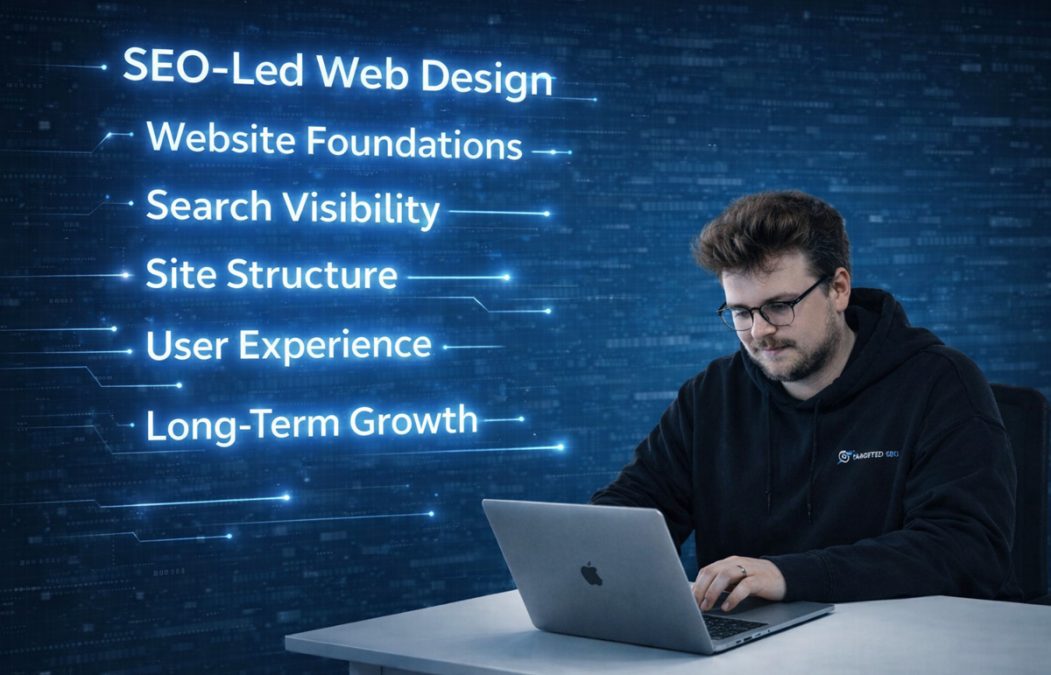
If your website is difficult to use, even for simple things like uploading a case study or changing a title tag, it can quietly become a bottleneck for SEO. Time ends up being spent working out how the site functions rather than improving it strategically.”
Conor Cresswell – Targeted SEO Web Designer
The real benefits of SEO web design for small businesses
For SMEs, the biggest benefit is efficiency and faster, more reliable results.
When your website is structurally sound and technically robust, SEO efforts compound over time instead of constantly resetting. Content performs better. Technical improvements last. Growth becomes more predictable.
SEO web design also protects your budget. Instead of paying for SEO to work around limitations, you invest once in solid foundations that support everything that follows.
Just as importantly, it creates a website that’s easier to understand, easier to use, and easier to trust. That’s great for AI tools, search engines and, of course, customers.
Research consistently shows that faster loading websites see higher engagement and lower abandonment, reinforcing the link between performance, usability, and SEO outcomes
This is why web design underpins our whole approach to SEO consultancy and website migration services.
When SEO web design is the right move
Not every business needs a new website.
If your current site is well structured, fast, and adaptable, SEO improvements may be enough. But if growth has stalled despite ongoing SEO, or if technical limitations keep resurfacing, it’s often a sign the foundations need attention.
The key is knowing the difference before investing further. So it’s best to start with an objective website and SEO audit to see if optimisation will be enough, or whether a rebuild is necessary for better results.
A smarter starting point for SEO and website growth
Before committing more budget to SEO, it’s worth understanding whether your website is helping or hindering your growth.
At Targeted SEO, we look at websites as part of the SEO ecosystem, not separate from it. We assess structure, performance, content, and usability together, because that’s how search engines and users experience your site.
If you’re unsure whether your website is fit to support long-term SEO, we’ll give you a clear, honest view through an SEO consultation or SEO audit. No pressure. No default recommendation to rebuild. Just practical guidance on what actually needs to change, and what doesn’t.
Investing in an SEO-optimised website without the ability to maintain it or grow it with content is like buying an expensive plant and never watering it. The website might look good at launch, but without ongoing care it will never deliver long-term results.”
Conor Cresswell – Targeted SEO Web Designer
Talk to Targeted SEO today about SEO website design
At Targeted SEO, we take a considered, evidence-led approach to website design and SEO. We look beyond surface issues to understand how your site supports visibility, usability and long-term growth, with clear guidance you can trust.
If you’re exploring whether SEO web design is right for your business, our SEO website design service can put your business on the right track from day one.
Common questions about SEO web design
What is the difference between SEO web design and normal web design?
Traditional web design focuses on how your website looks visually. SEO web design starts with visibility and performance, shaping structure and content so search engines and users can find and use the site effectively. This results in a site that supports visibility rather than fighting against poor foundations.
Is SEO pointless if my website is poorly built?
SEO is significantly less effective when the underlying website is not structured, fast, mobile-friendly, and usable. Fixing these foundational issues often unlocks the performance SEO has been struggling to achieve.
Do I need a new website to benefit from SEO web design?
Not always. Some sites benefit from targeted SEO improvements to structure, content, and speed without a full rebuild. The key is identifying whether the core issues are strategic (structure and layout) or systemic (platform or code limitations).
Why does SEO work better when it’s built into web design?
SEO works better when it aligns with design and development. Decisions about layouts, navigation, load speed, and content placement all influence how search engines crawl and rank your site. A cohesive approach avoids costly patches later and builds a more resilient foundation for growth.
Got this far? You might be intersted in: How much does a website cost?