
If you’ve ever worked with an SEO agency or dabbled in growing your own website, you’ve probably heard the word “optimisation” used to describe all sorts of things. But when it comes to SEO content, there’s an important difference between optimising something before it’s published and going back to improve a page that’s already live.
At Targeted SEO, we do both. Our in-house SEO content writers work alongside our strategists to optimise new blogs, service pages, and landing pages, as well as improve existing content that’s been published for months or even years.
That’s why we’ve written this guide. We’ll take you behind the scenes of how we approach content optimisation and reoptimisation, explain when each one is needed, and show you why updating what you already have can sometimes be just as valuable as creating something new.
Eager to learn what your website needs? Keep reading or contact our friendly team.
What is SEO content optimisation?
SEO content optimisation is the process of preparing new content for search before it is published. It involves much more than slotting in a handful of keywords.
We look at what someone is actually searching for and why. We consider the questions they might have, the information they expect to find, and how the page fits into the rest of your website. We also need to make sure search engines can clearly understand the subject of the page.
Then there’s the human side. Does it read naturally? Does it sound like your business? Is the most useful information easy to find? And, once somebody has finished reading, is there a logical next step?
A well-optimised page has to balance all of these things.
Where it sits in the process
At Targeted SEO, optimisation comes towards the end of the content production process, but SEO thinking starts much earlier.
Our SEO strategists carry out keyword and competitor research and look at search intent before our writers get to work. That research helps shape the content brief, structure, and topics we need to cover.
Once the first draft is ready, we optimise it.
What happens in an optimisation?
Writing for your audience and writing for search engines can look very different. Our job is to bridge the gap by refining your content so that it performs as well as possible in organic search without losing your brand’s original voice or message.
For our content writers, this process includes:
- Reviewing the content against the target keyword and search intent to ensure every section is relevant, helpful, and continues to answer the overarching question, and rewriting content where necessary
- Identifying missed opportunities to naturally incorporate additional relevant keywords and related terms, and ensuring that existing keywords and terms are used in a way that machines and search engines understand the concepts and relationships between them, rather than just matching exact keywords – this is called semantic SEO
- Expanding on key topics (where relevant) to answer common user questions, improve topical coverage, and improve readability
- Optimise headings and metadata
- Add internal linking to relevant pages to give more context and support the user’s journey
Alongside SEO improvements, we refine the overall quality of the copy by checking grammar, punctuation, spelling, tone of voice, readability, and consistency. We remove repetition, improve sentence structure, fact-check claims where necessary, and make relevant tweaks to ensure the content accurately reflects your brand and industry expertise.
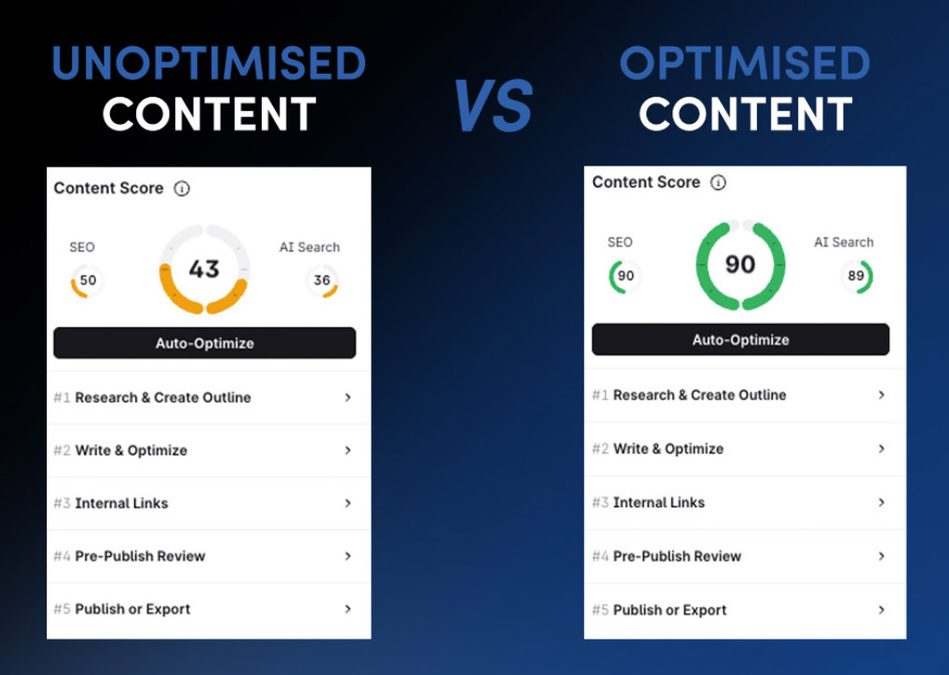
What is SEO content reoptimisation?
SEO content reoptimisation is the process of revisiting a page that’s already live and improving it using current search data and SEO best practice.
Sometimes we’re working with content we originally wrote. Other times, we’re looking at content that our in-house writers didn’t write, so the tools, experience, and approach would have been different to what we use today. This means it may no longer serve its purpose for SEO and search intent, so we’ll improve it for flow and readability alongside its SEO performance.
Why published content doesn’t stay optimised
The SEO landscape is always changing (we’ve had six major Google updates already this year), which means website content must be updated from time to time to reflect the latest algorithm changes.
Beyond algorithm changes,
- New competitors enter the search engine results pages (SERPs) every day, and it only takes one to publish something more recent or more relevant to outrank you
- Search intent shifts, meaning the same query your content ranked for 3 months ago might require something different today
- Facts, figures, prices, and external links become outdated
- AI assistants cite content that’s meaningfully fresher than what ranks in traditional organic search results
So even “evergreen” content (topics that will always be relevant) will need updating from time to time to please new audiences and new search algorithms.
What happens in a reoptimisation?
During a reoptimisation, our SEO strategists carry out fresh keyword research, analyse search intent, review competitor pages, improve the structure and readability of the content, and identify areas where additional or updated information is needed.
Then it goes over to our SEO content writers to:
- Review the existing content and updated layout
- Run plagiarism detection to ensure no content is duplicated across the internet or your website (and rewrite that content if required)
- Check for spelling and grammatical errors
- Remove any outdated content
- Tweak or rewrite existing content so that it fits your brand voice, better supports the reader experience and user search intent, and meets the latest SEO best practices
- Optimise headings and metadata
- Fill any content gaps to ensure the blog or service page answers every possible question related to the topic – this helps your content be cited in conversational search (aka AI)
- Identify opportunities to optimise CTAs or add new ones for CRO
- Add internal linking to relevant pages to give more context and support the user’s journey
- And ultimately ensure the page provides the most valuable, relevant answer for users
Reoptimisation doesn’t mean starting again
This is important to remember. A live page carries accumulated value, such as indexed history, backlinks, internal links pointing at it, and whatever authority it’s built. Our job is to preserve that and improve on it.
Full rewrites happen, but they’re a strategic decision, not a default.
And thankfully, Google has always valued high-quality, relevant, helpful content, which is built into the foundation of our SEO content services. But we also regularly review old content to see whether there’s a less competitive keyword we can target or changes we can make to improve it for new audiences and new search algorithms.
Content optimisation vs content reoptimisation at a glance
The easiest way to see the distinction is to compare the two processes side by side.
| Optimisation | Reoptimisation | |
|---|---|---|
| Starting point | Client draft or new piece of content | Existing live website content |
| Main goal | Prepare content for publishing | Improve content that is already published |
| Why | To satisfy SEO strategies and fill content gaps on a website | Rankings slipping, algorithm updates, outdated information, or a page that never performed |
| SEO focus | Search intent, keyword use, structure, and readability before publishing | Update keyword research, improve search intent, fill content gaps, and match current search results |
| Typical changes | Tweaking, expanding, and restructuring draft content | Updating, rewriting, expanding, or repositioning existing content |
| Best for | New blogs, service pages, guides, and landing pages | Older pages, underperforming blogs, outdated service pages, or pages with ranking potential |
| Outcome | A stronger piece of content before it goes live | A more useful, accurate, and competitive version of an existing page |
| How often | Once per piece | Old content is reviewed periodically and reoptimised when changes arise |
Which is more valuable: new content or updating old content?
Now that really depends on your SEO strategy, which is defined by your business goals. But at Targeted SEO, we do both. We look at your existing content, search performance, competitors, and commercial priorities before deciding where our time is best spent.
Sometimes the biggest opportunity is a topic your website hasn’t covered yet. We’ll suggest a new service page, guide, or article that lets you target that gap and increase the number of relevant searches your website can appear for.
In other cases, your biggest opportunity is through content that’s already on your website. We might see a blog ranking on page two for an important search term, a service page that gets impressions but fewer clicks than we’d expect, or perhaps a previously successful article that has lost visibility as search results changed. Reoptimising this content can make more sense than publishing something new as it already has relevance to build on.
How often should content be reoptimised?
A reoptimisation only makes sense when there’s a reason to act, such as when rankings or organic traffic have changed, information is becoming dated, search intent has shifted, keyword research reveals a new opportunity, or competitors are providing a more complete answer.
Common misconceptions about SEO content
There are a few misconceptions around SEO content that come up time and time again. And they’re understandable. If a blog is timeless or already ranking well, why would you need to revisit it? Here are some of the questions and assumptions we often come across.
- “It’s evergreen, so it never needs touching.”
Evergreen refers to the topic, not the page. Competitors and search engines change, and your content must adapt. - “It ranks, so it’s fine.”
Ranking third today doesn’t mean you’ll be there in six months, and traditional Google rankings aren’t the only form of search visibility anymore. We also consider AI search, featured results, and the different ways people now discover brands online. - “Optimisation just means adding keywords.”
There’s more that goes into the optimisation process than you might think. It involves writing, rewriting, adding context, tweaking the flow, and making the entire piece feel relevant and unique. - “Reoptimisation means starting again.”
Usually the opposite. The point is to protect what the page has already earned and build on the gaps that make it go further.
Make your content work harder with an SEO content audit
If you’re wondering whether your website needs new content or your old content needs updating, a sitewide content audit can tell you more. Our SEO content strategies typically involve a mix of reoptimising existing content alongside adding new content to fill gaps on your website. We’ll always tailor these strategies to your commercial goals.
Want to learn more? Call Targeted SEO on 0800 2062673 or complete our contact form for a free SEO consultation to see how your website is performing.