If you operate in a regulated or high-risk sector, you already know that writing content carries a big responsibility. These are known as “Your Money, Your Life” (or YMYL) topics.
What you publish can influence financial decisions, healthcare choices, legal outcomes, or reputational trust, which means content is held at a much higher standard.
You’ve likely heard of E-E-A-T. You may even reference it in marketing meetings. But what does it actually mean in practice? And how does it influence how Google (and now AI-driven search systems) interpret, summarise, and present your business?
For companies where accuracy, governance, and reputation are important, E-E-A-T is not just a funky acronym. It’s the foundation of good content!
Key Takeaways: E-E-A-T and SEO Content Quality in 2026
- E-E-A-T stands for Experience, Expertise, Authoritativeness and Trustworthiness. It’s a quality framework used by Google (and reflected in AI search systems) to assess whether content is credible, accurate and safe to surface.
- It is not a direct ranking score. Google doesn’t assign an “E-E-A-T rating,” but it uses a wide range of signals to evaluate whether your content demonstrates these qualities, especially in sensitive industries.
- E-E-A-T is critical for YMYL (Your Money, Your Life) sectors. In industries such as finance, healthcare, legal and other regulated fields, content is judged to a higher standard because it can directly impact someone’s health, finances, safety or reputation.
- Google evaluates quality holistically. Signals include:
- On-page clarity, structure and depth
- Off-page reputation (brand mentions, backlinks, reviews)
- Technical trust signals (HTTPS, usability, compliance)
- User engagement and satisfaction
Quality is assessed across your entire website, not just individual pages.
- AI search increases the importance of authority and consistency. Generative AI tools summarise and interpret content. Clear expertise, structured information and consistent brand messaging increase the likelihood your content is accurately represented.
- Experience means demonstrating real-world knowledge. This includes practical examples, case studies and insights drawn from genuine professional situations.
- Expertise requires depth and credentials. Strong E-E-A-T content shows qualifications, certifications, accurate claims and reliable supporting evidence.
- Authoritativeness is built internally and externally. Consistent branding, media mentions, industry citations and a strong online reputation reinforce credibility.
- Trust underpins everything. Transparent contact details, clear disclaimers, secure infrastructure, up-to-date content and compliance processes all strengthen trust signals.
- E-E-A-T directly supports SEO performance and conversions. Strong authority signals improve organic visibility, while clear, trustworthy content reduces friction and improves lead quality and conversion rates.
- Regulated sectors require structured quality controls. This may include named authors, credential verification, balanced risk explanations, compliance-aligned language and regular content review cycles.
- E-E-A-T is ongoing, not a one-off task. It requires regular audits, updates, author reviews and governance processes to maintain accuracy and consistency site-wide.
- AI can support or damage E-E-A-T. It can help with research and structuring, but without expert oversight it risks hallucinated facts, oversimplification and inconsistent messaging.
- Common E-E-A-T mistakes include:
- Publishing content without clear authorship
- Outdated statistics or claims
- Inconsistent messaging across channels
- Ignoring technical trust signals
- Treating E-E-A-T as a checklist rather than a long-term framework
- In 2026 and beyond, trust is a competitive advantage. As AI search amplifies both strong and weak signals, businesses that embed E-E-A-T into their SEO, content strategy and wider marketing will be better positioned for sustainable visibility and growth.
What is E-E-A-T in SEO and why is it so important?
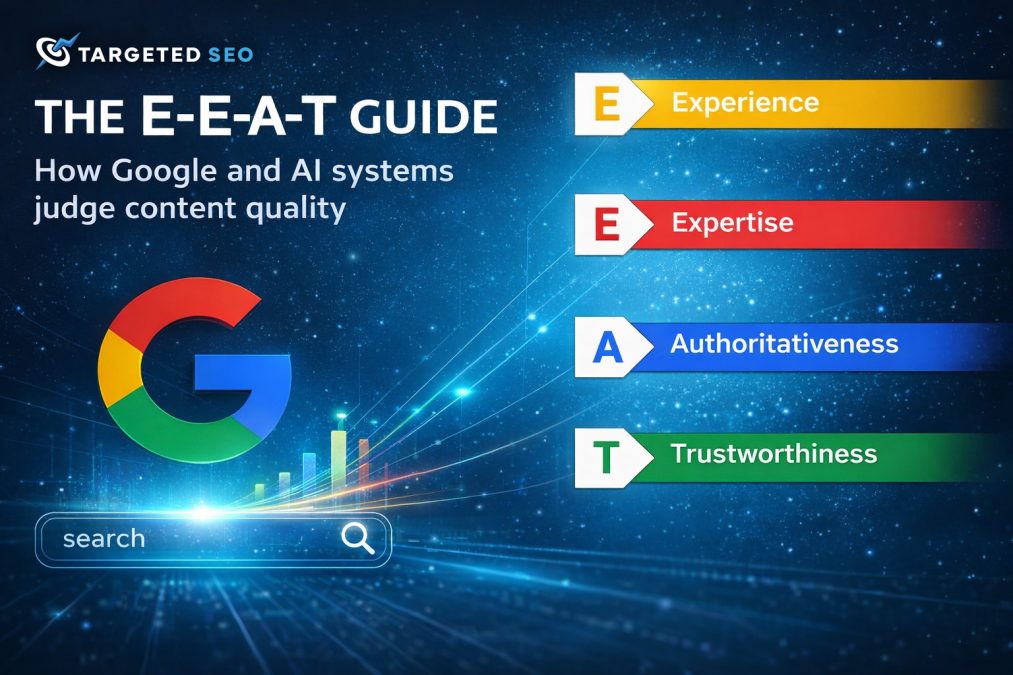
E-E-A-T stands for:
- Experience: Sharing first-hand experiences and telling real-life stories your audience can relate to.
- Expertise: Having the qualifications, knowledge, and skills to write honestly about a topic.
- Authoritativeness: Showing up as a reliable expert online. This could be through reviews, qualifications, website bio, and social media presence.
- Trustworthiness: Writing content that is honest and accurate, backed by a technically sound website.
It is not a ranking factor in isolation. Google does not assign you an “E-E-A-T score”. Instead, E-E-A-T is a framework used within Google’s Search Quality Evaluator Guidelines to define what high-quality content looks like, particularly in sensitive or high-impact industries, which we’ll get to shortly.
So, why does it exist?
Because search engines are responsible for surfacing information that influences real-world decisions. In sectors such as medical and healthcare, finance, renewable energy, and legal services, otherwise known as “Your Money, Your Life” (YMYL) topics, poor information can cause serious harm, financial loss, medical risk, legal consequences, reputational damage, the list goes on…
As search evolves, E-E-A-T has become more important.
How does Google evaluate content quality?
Google evaluates content using a combination of:
- On-page signals (clarity, structure, depth, and accuracy)
- Off-page signals (brand mentions, backlinks, and online reputation)
- Technical signals (website security and usability)
- Behavioural indicators (reader engagement and satisfaction)
This means it looks for evidence that your content:
- Reflects real-world experience
- Demonstrates thorough subject knowledge
- Is supported by credible sources
- Is written with user benefit in mind
Importantly, Google looks at quality across your whole website, not just its individual pages. So when your messaging is consistent and your content is up to date throughout, it strengthens your credibility everywhere.
Where does AI fit into it?
With AI-driven search experiences summarising and interpreting content on behalf of users, search engines now need much stronger signals to determine what is credible and safe to surface.
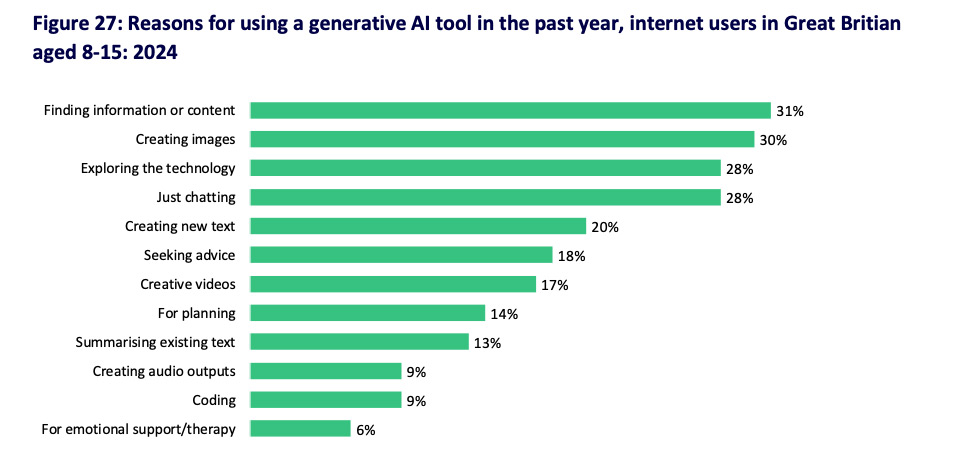
Recent data from Ofcom’s Online Nation 2024 Report shows that millions of people are using generative AI tools like ChatGPT, Gemini, Copilot, and others to find information and answers online.
Ofcom Online Nation Report
And search behaviour is shifting with it.
Queries are getting longer, more specific, and more conversational. Instead of typing two or three keywords into a search bar, users are asking full questions and expecting in-depth responses. In turn, AI generates detailed, conversational summaries.
That can lead to risk.
When AI systems pull information from across the web to construct an answer, they rely heavily on authority signals, consistency, and clarity, much like Google. So the clearer and more consistent your authority signals are, the more likely your content is to be surfaced accurately and represented in a way that reflects your brand and expertise rather than distorting it.
Read more about how to optimise E-E-A-T for AI search.
Breaking down E-E-A-T in practice
E-E-A-T can feel theoretical. In reality, it is deeply practical. It shows up in how you write, how you structure information, how you present credentials, and how consistently your brand communicates.
Let’s look at each component.
Experience – (in other words, demonstrating real-world understanding)
Experience is about showing that you’ve worked within the subject you’re discussing.
It’s your opportunity to move beyond surface-level commentary and offer something more valuable, involving context, nuance, and your own professional insight. In regulated sectors, your audience needs reassurance that you know what you’re talking about, especially when it comes to possible rewards and risks involved.
In practice, that looks like:
- First-hand knowledge from real situations
- Practical examples that show how things work
- Specific scenarios and case studies
Expertise – (essentially proving your subject knowledge)
Expertise is about going below the surface. Deep content addresses all areas of a topic, while surface-level content avoids them.
For businesses in high-risk sectors, building confidence means clearly demonstrating:
- Qualifications and professional credentials
- Relevant certifications
- Accurate statements backed up with reliable evidence
Authoritativeness – (aka building credibility)
Authority is earned externally as much as internally. It’s not about how much you write. It’s about making sure it all matches up.
Consistency across channels matters. When your website, LinkedIn profile, and other social media profiles tell the same story, it strengthens your online reputation. Using a clear and consistent tone and message on every page helps people and Google understand who you are and what you stand for.
That includes:
- Brand recognition
- Media mentions
- Industry citations
- Strong online reputation
Trust – (where the foundation of lead generation lies)
Trust underpins everything. A technically sound website makes your audience’s lives easier and helps Google read your content too.
That includes having:
- Transparent contact details
- Clear policies and disclaimers
- Secure technical infrastructure (HTTPS and privacy compliance)
- Accurate and up-to-date content across your website
How E-E-A-T affects SEO performance
Strong authority signals help search engines understand your site better. It’s about far more than keywords. Showcasing clear expertise amplifies your relevance on a topic, and staying consistent helps search engines crawl your site more effectively.
Over time, this strengthens organic visibility.
But the impact goes further. When you are consistent with it, E-E-A-T
- Improves lead quality because better-informed users feel more ready to convert
- Reduces compliance risk in highly-regulated industries
- And supports long-term website growth
E-E-A-T in regulated and high-risk industries (YMYL)
“Your Money, Your Life” (YMYL) topics include sectors where misinformation can directly impact someone’s health, finances, safety, or wellbeing. In these industries, content is judged at a higher standard.
Financial Services
In finance, there is very little room for ambiguity.
Investment guidance, lending criteria, tax implications, or insurance advice must be accurate and compliant with regulatory standards. Misleading claims can expose your business to legal and financial risk.
Strong E-E-A-T in finance means:
- Clear author input and professional credentials
- Balanced explanations of risks as well as benefits
- Language aligned with FCA expectations
- Transparent disclaimers where appropriate
- Consistent messaging across all channels
When we deliver SEO in finance, we build these controls into the strategy from the start. This involves having a clear review process, technical SEO that builds trust, and content structures that focus on clear information backed by your expertise.
Read our article on how AI search is changing SEO for financial services.
Healthcare and medical
Healthcare content influences patient decisions.
Patients use search engines to understand symptoms, research procedures, compare providers and assess risk. And patient safety is paramount.
Strong E-E-A-T in healthcare means:
- Named authors with verifiable credentials
- Clinical accuracy supported by evidence
- Clear explanations of suitability, risks, and limitations
- Transparent treatment outcomes
- Regular content review cycles
When we apply healthcare SEO techniques, we focus on building content that is factual and clinically correct. That includes implementing schema for medical content, carefully structuring treatment pages, aligning practitioner profiles and service pages, and using your clinical knowledge to support content.
Legal and professional services
Legal content requires precision to avoid being misinterpreted.
Unlike general information, legal advice must be precise, carefully framed and appropriately caveated. Over-simplification (especially in AI-generated summaries) can distort meaning.
Strong E-E-A-T in legal services involves:
- Clearly stated areas of practice
- Verified claims about experience or results
- Case studies where relevant
- Consistent branding across the website and media
- Accurate and well-worded service descriptions
When we deliver professional, legal SEO, we focus on creating content that improves search visibility and builds trust. This includes organising services clearly, refining the language on pages carefully, using strategies that enhance brand strength across digital channels, and working closely with you to ensure consistency and accuracy across your website.
Why E-E-A-T needs constant quality management
E-E-A-T is not a one-off project. It should be embedded site-wide. SEO content must be reviewed, updated, and maintained regularly to ensure consistency and accuracy.
This means:
- Regular audits
- Author reviews
- Compliance checks
- And updating outdated pages
This is why E-E-A-T aligns naturally with ongoing SEO retainers, because it’s what we’re already working hard to implement.
AI automation and E-E-A-T
AI is neither inherently harmful nor automatically beneficial. It depends on how you manage it.
| Where AI can support E-E-A-T | Where AI increases risk |
|---|---|
|
|
Common E-E-A-T mistakes businesses make
It’s easy for things to slip through the gaps, especially when you’re just starting out.
Common examples include:
- Publishing content without clear authorship or credentials
- Inconsistent messaging across pages
- Outdated statistics or claims
- Treating E-E-A-T as a checklist rather than a framework
- Ignoring technical trust signals (like schema and site performance)
- Forgetting the reader’s needs
How E-E-A-T supports leads and sales (and not just SEO rankings)
Of course, SEO rankings are a non-negotiable when it comes to reaching and selling to your audience, but they only get you so far. The rest of the work lies in conversion.
When you rank in Google or AI search, it builds visibility, but there’s still work to be done to build trust. And that work lies in conversion rate optimisation (or CRO).
Every day, your potential customers are searching for:
- Solutions you provide
- Problems you solve
- Competitors you compete against
Strong E-E-A-T improves CRO by reducing friction. It answers questions before they are asked. SEO and CRO are not separate disciplines; E-E-A-T connects them.
How visibility and E-E-A-T work together
| Visibility | E-E-A-T | Commercial Result |
|---|---|---|
| More high-intent traffic | Higher trust | More conversions |
| Broader keyword ownership | Strong brand perception | Higher close rates |
| Consistent presence | Authority signals | Lasting security |
So, what does E-E-A-T mean for your business in 2026?
In 2026, E-E-A-T is fundamental to SEO. AI search amplifies both strong and weak signals, and trust is a competitive advantage.
E-E-A-T works across channels. It’s vital for SEO, which is a long-term, sustainable investment, but it also brings the rest of your marketing efforts together. A good blog can be repurposed into LinkedIn content, an Instagram post, or even tweaked and turned into an engaging script for videos and podcasts.
Make E-E-A-T part of your marketing strategy with Targeted SEO
If you’re in a regulated or high-risk sector, like healthcare, finance, renewable energy, or legal, and want your digital presence to reflect your expertise accurately and consistently, we’d love to chat. Speak to us about our E-E-A-T-focused SEO strategies and learn more about how we can help.
FAQs about experience, expertise, authoritativeness, and trustworthiness
How does E-E-A-T affect AI search results?
AI systems use authority signals to decide which content to summarise and display. These signals include showing clear expertise, providing well-structured information, and maintaining consistent messaging. Together, they help increase accurate representation in AI search.
Is E-E-A-T more important for certain industries?
Generally speaking, E-E-A-T should be carefully considered for all industries if you’re looking to gain trusting and loyal customers. However, there are some industries where experience, expertise, authoritativeness, and trustworthiness are detrimental to the safety and wellbeing of your audience.
E-E-A-T is particularly important when writing about healthcare, finance, legal, and similar topics. This is because the content you write can have a serious impact on the reader’s health, finances, and wellbeing, so it must be factual, honest, and backed up by your professional (and sometimes personal) experiences.
How can businesses improve E-E-A-T on their website?
Improving E-E-A-T starts with being clear about who you are, what you know, and why someone should trust you. That means sharing real-life experiences, highlighting your qualifications, keeping messaging consistent, and having an updated, secure website. In regulated or high-risk sectors, it’s also important to have internal quality checks in place.
Does AI-generated content harm E-E-A-T?
It sometimes can. If AI content is not properly reviewed and tweaked, it can contain inaccurate, misleading, or generally bland information that could negatively impact E-E-A-T ranking factors, hinder your search engine optimisation, and, in worst-case scenarios, lead readers to follow the wrong advice. The best advice is to properly review your content and only use AI as an assistant, not a writer.
You may be interested in the cost of professional SEO website content which satisfies E-E-E-T.