Like all areas of marketing, SEO is constantly changing. Algorithms change, technologies advance, new trends appear, and audience habits change.
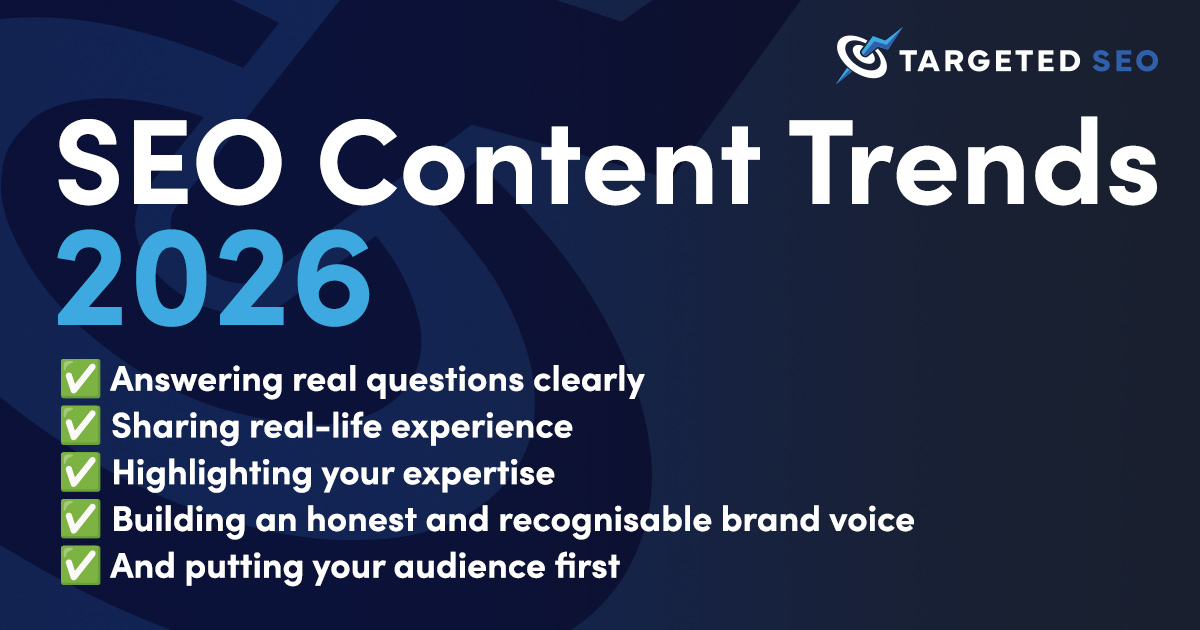
In 2026, SEO content is about leaning into your own human experience, developing a clear brand voice, and creating genuinely helpful answers. Focus on E-E-A-T and on content that puts your audience first, and you’ll be in a strong position going into the year ahead.
In this jam-packed blog, we’ll start off by breaking down the key SEO lessons we learnt in 2025 and give you the roadmap for creating impactful content in 2026.
What happened with SEO in 2025?
Before diving in headfirst, let’s take a moment to reminisce on the past year.
2025 was a busy year for SEOs everywhere and for us at Targeted SEO. From Google updates and the rise of AI to our third year at Brighton SEO, we saw it all… and made it through.
Notable Google updates
In 2025, Google’s search algorithm continued doing what it does best: keeping everyone on their toes.
Core updates throughout the year reinforced a clear message that shortcuts don’t last. Websites relying on thin or AI-generated content found it harder to stay visible, while those focusing on useful, well-thought-out content and a good user experience saw steadier results.
If your content genuinely helped users, answered real questions, and aligned with search intent, it stood a much better chance of holding its position.
The AI takeover
- More zero-click searches
In 2025, AI Overviews (SGE) evolved further, making AI summaries and AI answers instantly available without a scroll or click, to more users worldwide. - E-E-A-T skyrocketed
Experience, Expertise, Authoritativeness, and Trustworthiness (aka E-E-A-T) became the primary defence against low-quality and AI-generated content. Proof, again, that content with first-hand experience and real expertise will always win. - Core web vitals
Google confirmed that performance signals aren’t just about raw page load speed, with updates to Core Web Vitals documentation. It’s about how your site feels to use. Smooth navigation, readable content, and good user experience (UX) continue to fuel SEO strategies.
SEO fundamentals haven’t changed, but it’s clear we need to keep up to protect search rankings.
So, what’s in store for content SEO in 2026?
Let’s look ahead.
Based on what we’re seeing across client websites, search results, our own website, and industry conversations, here are the key content SEO trends the Targeted team predict for 2026.
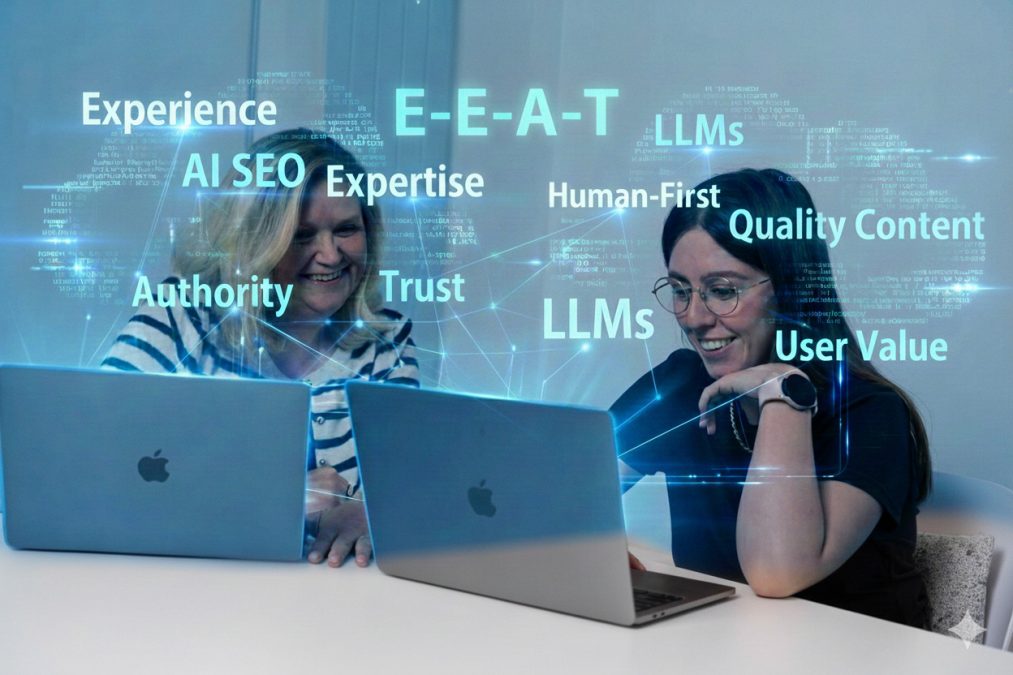
AI SEO and LLM optimisation
We’ve said it before, and we’ll say it again. AI isn’t going anywhere.
But how you show up in AI-powered search results is already changing. And that’s what many businesses are really trying to understand right now.
We’re starting to see more SMEs appear in AI Overviews and conversational search results. Not because they’re doing anything flashy, but because their content is genuinely useful. Large language models (LLMs) tend to pull from content that’s clear, well-structured, and grounded in real experience. In other words, content that sounds like it’s written by someone who knows the subject and their audience.
This means:
- Answering questions your audience is actually asking and answering them clearly
- Backing up your points with well-researched data, real-life examples, and case studies
- Structuring blogs with question-based subheadings, lists and tables, structured data, and metadata
- Making your content relatable by sharing first-hand experience and quotes
- Showing real understanding of your industry, not just repeating keywords
Essentially, good SEO = good LLM visibility
Keyword and topical research is still important. It shows you what your audience is searching for online, how they ask those questions and where those questions may lead. But keywords alone won’t carry your content anymore. You need context, clarity, and credibility.
If your content is easy to read, genuinely helpful, and clearly aligned with what users are trying to achieve, it stands a far better chance of being surfaced by AI-driven search tools. But that doesn’t mean “optimising for AI” in isolation. It’s still essential to create quality content that focuses on the reader and naturally supports AI visibility as a by-product.
At Targeted SEO, we’re already helping businesses stay ahead of the curve with AI SEO services and have been using SEO tools to track visibility across both traditional results and AI summaries. We believe this will become increasingly important in the year ahead.
Prioritising Google’s E-E-A-T guidelines
If it wasn’t already clear last year, Google places extreme importance on quality content that is created with the audience in mind. This means making it engaging, relevant, and reader-friendly.
We talk a lot about E-E-A-T here at Targeted SEO because it’s the cornerstone of good SEO.
E-E-A-T stands for Experience, Expertise, Authoritativeness, and Trustworthiness.
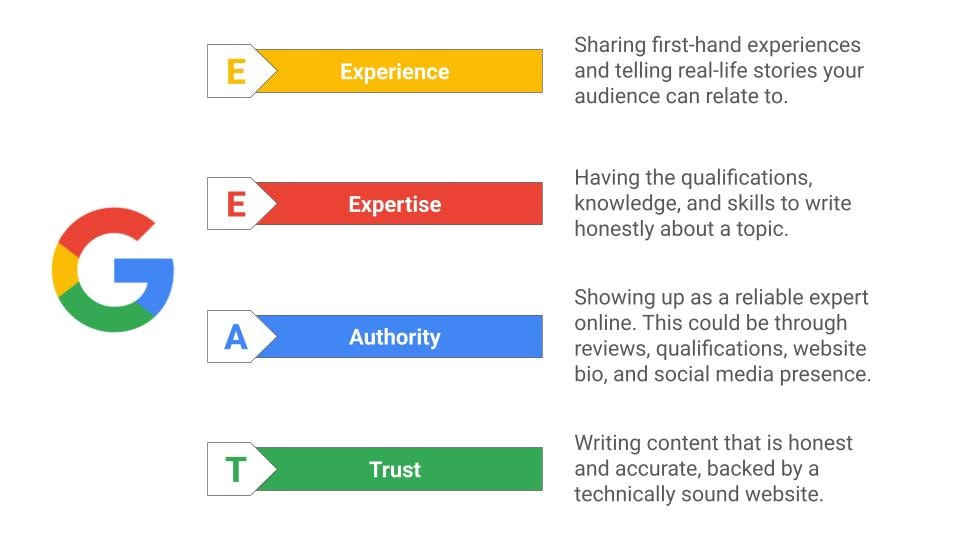
It doesn’t need to feel hard. At its core, E-E-A-T is about showing that you know what you’re writing about. Write from experience, share your knowledge, and back up what you say with reviews, case studies, and facts.
Don’t write content for the sake of it. Make sure everything you write serves a purpose, and don’t rely on AI to write all your content for you!
Yes, AI is fun to play around with, and it can produce a fairly decent response when prompted correctly, but it is unpredictable in search. Not to mention unreliable. Using AI solely to write content can lead to content biases, misleading or incorrect information, plagiarism, and problems with Google.
AI also lacks oomph.
We’re not saying don’t use AI. Instead, we recommend learning about it and using it to enhance your already top-notch work.
AI can be a great tool for:
- Planning content and generating fresh ideas (or getting over a creative block)
- Cutting down research time
- Creating outlines for blogs and webpages (with the right prompts!)
- Summarising long paragraphs
- Creating catchy and unique headings
- Finding topical synonyms, adjectives, and idioms
It shouldn’t be your personal content writer. It just won’t work.
Want to learn more? Check out our thoughts on AI content.
Focusing on your brand
Generic content blends in. Branded content stands out.
As we head into 2026, your brand voice will play a much bigger role in how your content performs, both with your readers and with search engines.
When users land on your site, they’re subconsciously asking questions like:
Can I trust this business?
Do they know what they’re talking about?
Do they understand me?
Building brand visibility means building trust (see how E-E-A-T keeps coming up). And trust is built through consistency, a clear tone of voice, messages that speak to your audience, and opinions that are backed up by experience, research, and social proof, instead of just surface-level statements.
If your content sounds like it could belong to anyone, chances are it won’t perform well.
But…
If your content sounds authentic and aligned with who you are as a business, it’s easier for readers to engage with it. And when your readers engage, search engines take notice too.
This doesn’t mean you need to be loud or overly opinionated in what you write. It just needs to feel intentional.
Your brand should also feel personal to you.
Think back to why you started your business in the first place – the problems you wanted to solve, the people you wanted to help – and let that guide how you communicate.
Creating a brand you’re proud of doesn’t just benefit your SEO. It makes your content more engaging, more relatable, and far more appealing to the audience you actually want to reach. It also supports branded search volume, which plays a growing role in long-term search visibility.
Matching audience search intent
Content that answers real questions will succeed.
Search intent is the “why” behind your audience’s typed query, and it’s becoming more conversational and more specific. With AI enabling us to find answers to almost anything, people aren’t just searching for keywords anymore. They are asking full questions and expecting helpful responses.
Search intent falls into four main categories:
- Informational – helps your audience learn something
- Navigational – helps your audience find a specific website or page
- Commercial – helps your audience research before buying
- Transactional – your audience is ready to take action
Your content needs to cater to what your audience is looking for.
People searching “how to…” are likely looking to learn a new skill or overcome a problem, while people searching “what’s the best…” are probably looking for the right product for their needs. Then there are the people searching for your brand. They already know what they want; they just need to determine whether they can trust you.
Before publishing anything, ask yourself:
- What is the user actually trying to achieve?
- What do they want to know at this stage?
Answer their questions clearly. Then optimise for search.
Giving users the best experience
User experience and search engine rankings go hand in hand.
Over the last year, we’ve seen a clear shift in how Google evaluates content. Yes, what you say is important, but it’s also about how easy it is for someone to read your content, understand it, and move through your site without friction.
Think about how you browse online. You skim. You scan headings. You abandon pages that feel “off” or too slow. Your audience does exactly the same.
That’s why things like short paragraphs, clear headings, logical structure, and fast-loading pages make such a difference. They help users get what they need quickly. When your users are having a good experience, Google will favour your website.
Core Web Vitals are a big part of this, but they’re only one piece of the puzzle. How your content reads, how it flows, and how it’s laid out all affect performance too. If your content is technically sound but hard to read, it’s still going to struggle.
From our experience, some of the strongest-performing pages aren’t the longest or filled with keywords. They’re the ones that feel easy to use. They answer questions clearly. They don’t make the reader work too hard.
Many adults in the UK spend around 1 hour and 48 minutes on social media each day, with users aged 18-24 spending the most time online.
Your audience doesn’t just live on Google. They’re scrolling LinkedIn, Instagram, TikTok; watching short-form videos; saving posts for later; and researching across different platforms before making decisions.
It’s not just younger generations. Even people over 65 spend a significant amount of time online, which makes sense for retirees who have more time on their hands. And remember, those younger generations will one day be 35, 45, or 65… so even if they aren’t now, they might one day become your audience.
A well-written blog post can (and should) do more than rank in search results. We’re seeing more and more that one strong piece of content can work across multiple stages of the customer journey.
When you create content, not only should you consider the trends we’ve already mentioned, but you should also write with flexibility in mind.
Your well-researched blog can also feed into:
- AI Overviews and conversational search
- Featured snippets in traditional search results
- Social media posts and carousels
- Transcripts for YouTube videos and podcasts
- Email content and sales conversations
The goal isn’t just to be found. It’s to be recognised and remembered wherever your audience happens to be spending their time.
Local SEO
If your business serves a specific area (or several), local SEO will continue to be one of the most effective ways to drive traffic in 2026.
We’re still seeing huge opportunities here, especially for SMEs. Local searches are often high-intent. People are looking for services near them and are ready to take action. Google (and increasingly AI search engines) are getting better at matching those searches with relevant local businesses.
A good local SEO strategy goes beyond adding a town name to a page. It’s about creating content that meets local needs. This includes creating pages for specific services, sharing local case studies, providing clear contact information, and keeping things consistent across your website and listings.
When done well, local SEO helps your business appear in search engine results at exactly the right moment, ultimately when your audience is nearby and ready to make a decision.
Human vs AI-generated content… who (or what) will perform better?
AI-generated content has its place, but on its own, it rarely delivers a competitive advantage.
AI systems are great at summarising existing information and producing quick drafts. But they don’t have lived experience. They don’t understand your customers. And they can’t add original insight in the way a human can.
From what we’re seeing, ranking pages that perform well over time tend to share a few things in common:
- Clear intent and structure
- Experience-led insight
- Strong content quality
- A recognisable brand voice
AI content can support content creation, but human-led content still does the heavy lifting when it comes to trust, relevance, and authority.
Search engines and AI engines are increasingly looking for signals that content is original and helpful. That’s where human input, user-generated content, reviews, and real-world examples really matter.
In short, AI can help you scale your SEO efforts, but it’s the real human input that makes you stand out.
Tips for SEO content success in 2026
So, how do you put all of this into practice without overcomplicating things?
Here are a few practical tips to keep your content strategy on track in 2026:
- Keep your content flowing with regular blogs, landing pages, and case studies
- Let your experience lead your content (this means sharing what you’ve seen, learned, and tested)
- Embrace AI tools for planning and efficiency, but remember to keep a human touch
- Get clear on the “why” before you start writing
- Focus on content quality over quantity
- Keep your brand voice consistent across web content and other platforms
- Make your content easy to scan and easy to read
- Optimise your content for AI Overviews and featured snippets
- Repurpose your content across social media platforms
- Review and refresh existing content regularly
- Invest in search engine optimisation with SEO professionals who understand how it’s evolving
Let your SEO strategy shine in 2026 with Targeted SEO!
At Targeted SEO, we help businesses create content that stands out. From keyword research and content strategy to AI optimisation and performance tracking, we focus on what will drive organic traffic and keep you visible as traditional SEO continues to evolve.
If you want support staying ahead of key trends, improving search visibility, and making your content work harder across search results, we’re here to help. Contact us today to discuss your SEO needs.