You launch a new website and excitedly await your first enquiries. Then nothing happens.
That silence is one of the most common frustrations for SME owners. You’ve invested time, money, and energy into your new site, but it seems invisible. The reality is simple. Brand-new websites (on newly registered domains), start with low trust, and many have technical issues that block visibility before you even get going. Without any thought for SEO, things are unlikely to improve.
Every new website needs SEO to send the right signals to search engines. Only then will it steadily build authority and start to become visible in search results. It starts with the right SEO foundations, including site structure, technical optimisation, high-quality content and great user experience.
It’s a case of “you can’t be great to start, but you have to start to be great”. So the sooner your site is optimised for search, the better. In an ideal world, SEO is built in before launch, but we can almost certainly work with what you’ve got.
In this guide, we’ll present our approach to SEO strategy for new websites, including traditional and AI search.
If you have just launched a new website, talk to us about how we can help turn it into a valuable lead machine for your business. If you have yet to build your site, better still, as SEO is much more powerful when it’s built in before launch. In which case, talk to us about our SEO web design services.
Why your new website needs SEO
Online visibility simply means showing up in Google and AI results when people search for your product or services. For example, if you run an accounting firm, you will naturally want to appear when someone searches “outsourced finance department” in your target location or niche industry.
The challenge is that a new website on a new domain starts with the needle at zero. Search engines have no history or trust signals to judge its credibility yet, so it won’t index the site. That is why it’s extremely rare for new websites to rank on page one (or anywhere near it) right away.
Google ‘crawls’ websites by following links and reading pages. If the site is well-structured, it can work out what the site’s about and who it’s for. It then indexes web pages, ready to recommend them in response to a relevant search query. It prioritises the search results based on how relevant, helpful, and trustworthy each page is.
The role of SEO (Search Engine Optimisation) is to help search engines and AI tools crawl, understand, and trust your site through a range of on-page and off-page techniques.
Steadily, over the course of months rather than weeks, this moves your site from invisible to visible.
The ultimate goal is to attract meaningful traffic to your site from your target audience. This type of organic traffic (i.e., users that find your website naturally through search results) is far more valuable and sustainable, offering you a much better return on investment than paid ads.
See how a new SEO-led website helped a care home quickly establish itself with local visibility in this case study.
How we implement SEO on new websites
Here is an overview of how we approach SEO for newly launched websites. I’ll briefly explain what we do and how we do it, without getting into too much technical detail or jargon. What’s important is why we do it and how it helps your site.
Phase 1: Website audit
Goal – Identify what’s holding the site back and where the opportunities are
Every project starts with an SEO audit to get a clear picture of how your website is currently performing.
Phase 1 checklist:
- Set up Google Search Console (if not already in place): We verify your site and submit the sitemap to GSC so we can access real search data. This tells us how the site is performing for clicks, impressions, search queries, and other key metrics.
- Technical SEO and crawlability: We review how easily search engines can access and crawl your site, and flag any technical barriers.
- Site structure and existing web pages: We look at how your content is organised to identify gaps, duplication, and structural issues.
- Site performance and user experience: We review things like core web vitals and mobile performance to see how easy your site is to use.
Phase 2: Technical SEO work
Goal – Make the site crawlable and indexable
Once we understand the issues, we can go about making improvements. We work through the audit findings systematically, resolving anything that prevents search engines from properly accessing and understanding your site.
Phase 2 checklist:
- Resolve crawl and indexation issues: This involves fixing blocked pages, noindex tags, and broken links. These issues often prevent entire sections of a site from being visible.
- Refine site structure: We improve how pages are linked and organised so search engines can move through the site more easily. A clear structure helps search engines understand relationships between pages and prioritise important content.
- Clean up duplicate and conflicting content signals: We address duplicate pages as they can seriously impact ranking potential.
- Improve technical performance foundations: We review load speed, mobile usability, and key performance elements such as image handling and script load. While we will continue to develop UX throughout the project, this stage ensures the site meets baseline expectations.
Phase 3: Keyword research and on-page SEO
Goal: Prove relevance in response to search queries
Once Google can crawl your website, we need to show it what to rank it for. The more relevant and helpful your site is, the more it will come to be a trusted source for both Google and AI search tools.
Phase 3 checklist:
- Define target keywords and search terms: Our SEO consultants carry out detailed research to identify relevant keywords your target audience is using in Google search.
- Map keywords to specific pages: We assign one primary topic and set of specific keywords to each page to avoid overlap or duplication. This helps search engines understand each page clearly and prevents pages from cannibalising one another.
- Align pages with search intent: We structure content around what users are actually looking for, whether that is information, comparison, or action.
- Create quality content: Good SEO content uses keywords naturally and is helpful, relevant and credible, in line with Google’s E-E-A-T guidelines. Importantly, it also enhances brands and drives conversions,
- Optimise on-page SEO elements: We refine titles, headings, and meta descriptions to improve visibility in SERPs (search engine results pages) and encourage click-throughs.
- Build internal links between relevant pages: We link between related pages for ease of navigation, both for search engines and users.
Goal – Build trust with both Google and users
Your site is beginning to be noticed and is full of relevant information. From there, it’s all about continuing to build trust and domain authority (a term widely used in the industry that assigns a score to how relevant and trustworthy the site is).
Just like humans, search engines like to gather as much evidence as possible to prove a business site’s authority. It gathers on-page signals such as quality content and user experience, and off-page signals such as external links from other websites, to decide which sites to prioritise. The more trustworthy your site appears, the more competitive your search rankings become.
Phase 4 checklist
- Build backlinks from relevant, credible websites: Where appropriate, we secure links from your partners, suppliers and industry associations to act as trust signals, increasing domain authority and helping your site compete with other websites.
- Earn links through high-quality content: We continue to fill the site with high-quality, relevant content that other sites naturally want to reference and link to.
- Strengthen on-site trust signals: On the page, we add testimonials, case studies, and clear contact information to signal that it is trustworthy.
Phase 5: Optimise performance and UX
Goal – Create a fast, user-friendly site to aid visibility and conversions
Search engines and people favour websites that load quickly, work well on mobile, and are easy to get around. So, creating an optimum UX is essential for both search visibility and conversions.
Phase 5 checklist
- Optimise site performance and load speed: A fast, stable, user-friendly site supports visibility and improves how users interact with your site. We improve load speed by compressing high-quality images, reducing scripts, enabling browser caching, and ensuring mobile responsiveness.
- Improve site structure and navigation: Our website navigation designs are clear, logical and scannable. This helps users find what they need fast, making them more likely to trust and take further action, e.g., get in touch or make a purchase.
- Add accessibility features: To make your site easier to use for everyone, we add elements like image alt text and ensure the content works with screen readers and different devices. This improves usability first, but also helps search engines better understand the content.
- Maintain site health as new pages are added: We continue to check regularly for broken links, duplicate content, and technical problems as it grows.
Phase 6: Track, refine and scale
Goal: Track performance, improve where needed and continue to grow the site
SEO is not a one-off task; it builds over time. By tracking performance, we can see what’s gaining traction and where improvements are needed.
Consistent effort, monitoring, and refinement are how we get consistent SEO results for our clients.
Phase 6 checklist
- Track performance in Google Search Console: We monitor traffic, impressions and clicks to measure the site’s performance. While these metrics are good indicators of success, we also urge clients to look at how organic visibility links drive conversions and quality of leads, to get a true measure of ROI.
- Identify opportunities from search data: We make actionable recommendations for improvements based on the analysis. For example:
- A page that has lots of impressions but a low click-through rate → further optimise titles and meta descriptions.
- Web pages hovering around page 2/3 of Google → improve content relevance and depth, and internal linking.
- Scale the site with a clear SEO strategy: We create and update content based on keyword research, search intent, and performance insights, to ensure it stays relevant and reflects your company’s goals.
How long does it take to do SEO on a new website?
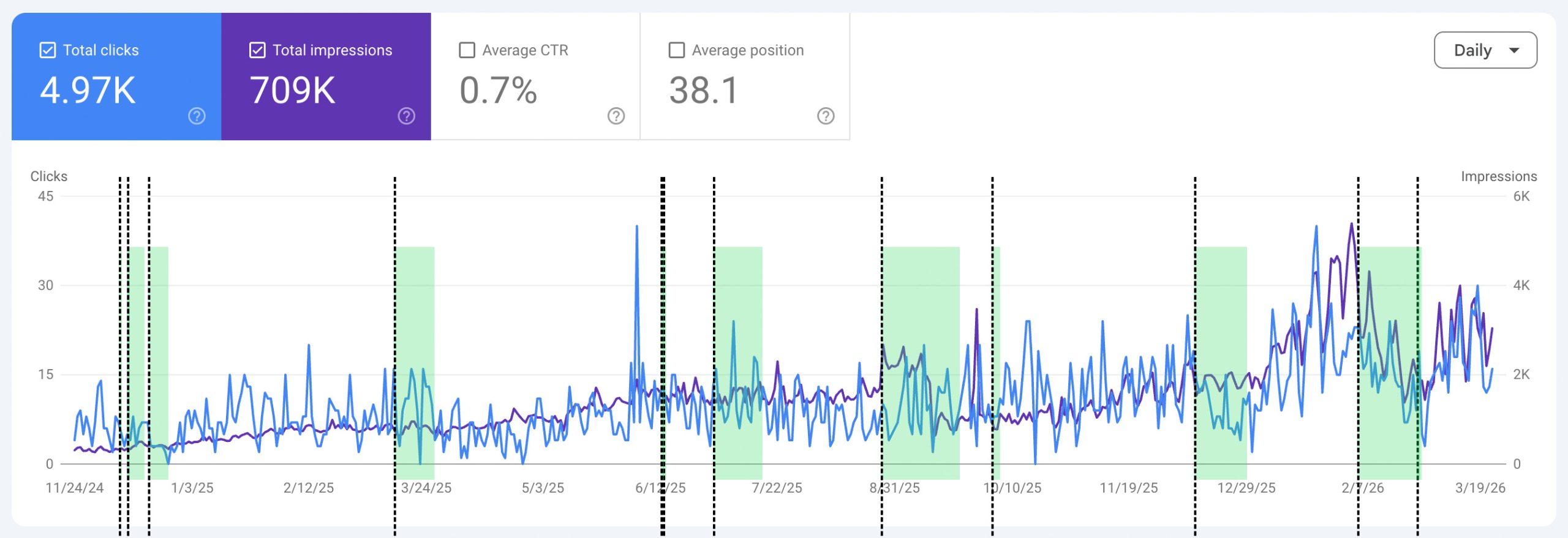
Organic SEO takes time. While we can fix the technical foundations in a matter of weeks, it takes months of continued effort to see real, measurable results. To see how this plays out, take a look at the results we achieved for one of our accounting clients over three years.
Here’s an example timeframe:
| Timeframe | Focus | What we’re doing | Why it matters |
|---|---|---|---|
| 0 days | Understand current performance | Audit technical SEO, site structure, content, and performance using tools like Google Search Console | This identifies what’s holding the site back and where the biggest opportunities are |
| 0–30 days | Fix foundations | Resolve crawl and indexation issues, clean up site structure, and ensure key pages are accessible to search engines | This ensures your site can be seen and indexed before any growth work begins |
| Improve targeting | Optimise core pages, map keywords, align content with search intent, and strengthen internal links | This helps search engines understand what each page should rank for | |
| 30–60 days | Build credibility | Begin building backlinks, add proof like case studies and testimonials, and create supporting content | This builds trust signals that improve your ability to compete in search results |
| Improve user experience | Optimise load speed, improve user experience, and ensure the site is easy to navigate and use | This supports both rankings and conversions once traffic starts to grow | |
| 60–90 days | Measure, refine, optimise and expand | Analyse performance data, optimise existing pages, and identify new content opportunities | This ensures early traction is improved rather than wasted |
| 3–6 months rolling | Rinse and repeat | Continue creating content, building links, improving pages, and acting on performance data | This is where SEO compounds into consistent traffic, stronger rankings, and regular enquiries |
Contact us to explore an SEO strategy for your website
SEO for a new website isn’t about quick wins. It’s about building solid foundations, proving relevance, and earning trust over time. Get that right, and your site could become a consistent source of high-quality enquiries.
If your website isn’t delivering yet, there’s always a reason and a solution. We’ll help you find both.
Get in touch to request a consultation and see how we can turn your website into a genuine growth channel for your business.
How long does SEO take to work on a new website?
SEO on a new website rarely delivers immediate results, and that’s completely normal. In most cases, the first few months are focused on building the right foundations. You may start to see early signs of progress within 2–3 months, but meaningful growth, traffic, enquiries, and consistent visibility, typically builds over 4–6 months and beyond.
Is it better to redesign a website before starting SEO?
In many cases, yes. If your current website is difficult to manage, slow, poorly structured, or built on a platform that limits growth, it can hold SEO back before it even starts. We often find that investing in a well-built, search-optimised website first creates a much stronger foundation. It means every piece of SEO work that follows has a better chance of performing. If you’re considering this, it’s important to approach it carefully to avoid losing any existing visibility. Here’s how we approach website SEO migrations to protect and improve performance.
How do you know if your new website is ready for SEO?
A website is “ready” for SEO when search engines can access, understand, and trust it. There are a few key signs to look for. Your pages should be indexed properly, your site structure should feel clear and logical, and your core pages should be focused on specific services or topics rather than trying to cover everything at once. It’s also important that there are no major technical issues in the background that could be holding performance back. If you’re unsure where you stand, a professional audit will quickly highlight what’s working and what needs attention. This is usually the first step in any campaign and something we cover in our SEO audits service.
Can SEO work without ongoing monthly investment?
Technically, yes, but it’s unlikely to perform well long-term. SEO isn’t a one-off task. Search results are constantly changing, competitors are improving, and new opportunities continue to emerge. Without ongoing work, performance often plateaus or declines over time. Consistent investment is what allows SEO to compound and become a reliable source of leads. You can see what happens in more detail when businesses pause activity in this guide on what happens when you stop SEO.
What’s the best way to start SEO for a new website?
The best approach is to start with clarity. Understand where your website is today, what your business actually needs from SEO, and what opportunities exist within your market. From there, you can build a structured plan that focuses on the right priorities, rather than trying to do everything at once. If you’d like a clearer picture of what this could look like for your website, you can get in touch with our team and we’ll talk it through.